I. The Hero’s Burden and the Combustion of Passion
In the social impact sector, we harbor a beautiful but fatal delusion: we treat “passion” as a perpetual motion machine. When budgets are tight and compensation packages cannot compete with the private sector, we ask our teams to accept a profound sense of purpose as a subsidy for their labor. Yet, passion is a finite, combustible fuel. It burns incredibly bright during a crisis, but without a sustainable source of psychological replenishment, it inevitably leaves nothing but the ash of burnout in its wake.
This dynamic is exacerbated by the “Hero’s Burden”—the antiquated leadership fallacy that non-profit executives must embody a stoic, hyper-critical vigilance. Operating in a perpetual state of triage, leaders often fixate entirely on the “gap” between current realities and the utopian mission. They assume that highlighting deficiencies is the only way to drive urgency. However, martyrdom is a spectacularly poor retention strategy in a digital-first world.
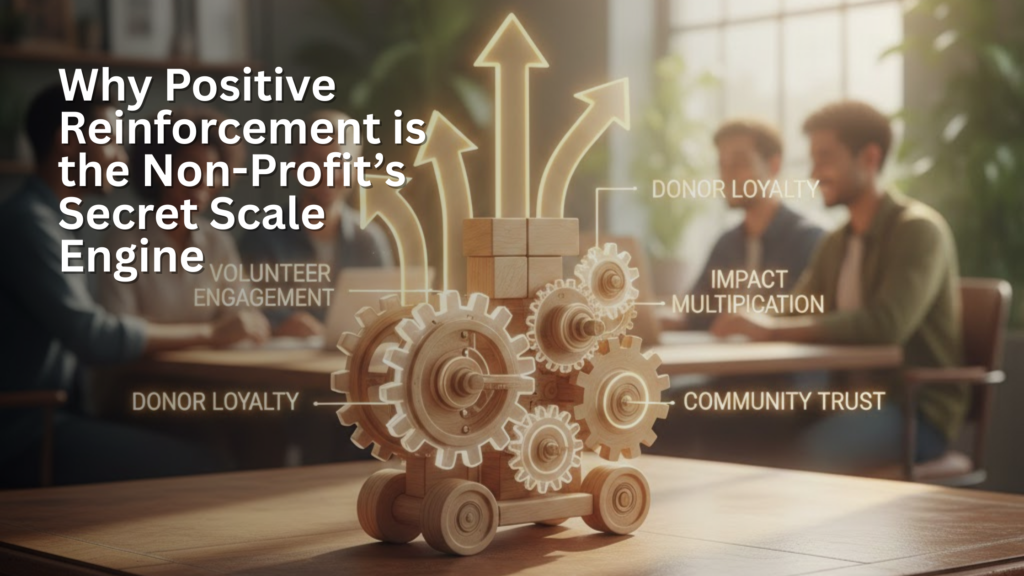
The psychological reality paints a starkly different picture. We are discovering that teams who feel profoundly “seen” and validated in their incremental victories are 31% more productive than those driven by the looming anxiety of failure. To build a positive culture in remote non-profits, we must stop treating passion as a fossil fuel to be extracted and start building a renewable energy grid. That grid is powered by positive reinforcement.
II. The Dopamine Loop of Impact
To understand why this works, we must briefly abandon the realm of philosophy and step into the neurobiology of recognition. Praise is often dismissed as a “soft skill”—a pleasantry traded over Slack when time permits. In reality, positive reinforcement in non-profit leadership is a highly sophisticated neurobiological lever. When a team member receives precise, meaningful recognition, the brain releases dopamine.
This dopamine rush is not merely a momentary emotional high; it is a profound learning mechanism. The brain’s reward system effectively takes a snapshot of the behavior that triggered the praise and encodes it as a “success template.” When a developer squashes a bug that was slowing down a donation portal, or a fundraiser lands a mid-tier gift through a creative outreach strategy, immediate validation tells their nervous system, “This behavior ensures survival and status within the tribe. Repeat it.”
By leveraging this dopamine loop, leaders do not just make their employees feel warm and fuzzy; they actively shape the cognitive architecture of their organization. You are essentially programming autonomy. Instead of micromanaging outputs, you are reinforcing the intellectual reflexes that allow a group of disparate individual contributors to fuse into a cohesive, problem-solving organism.
III. Combating the Scarcity Mindset
The non-profit ecosystem is uniquely vulnerable to the “scarcity mindset.” Organizations frequently operate under the oppressive cloud of “not enough”—not enough funding, not enough staff, not enough hours in the day to solve systemic societal failures. Unfortunately, this financial scarcity often metastasizes into psychological scarcity. Leaders begin to unconsciously hoard praise, operating under the bizarre heuristic that acknowledging a colleague’s success somehow diminishes their own authority or suggests the overarching mission is complete.
This is where positive reinforcement acts as a radical paradigm shift. It introduces a culture of abundance into an environment starved for resources. It costs zero dollars to validate a colleague’s intellectual labor, yet the dividends it pays in team retention for social impact are staggering. When successes are loudly shared rather than quietly filed away, the emotional temperature of the organization fundamentally changes.
Operating from abundance means recognizing that a win for the communications director is a win for the field operatives. It dissolves the silos that form when frightened people are competing for scarce resources and limited executive attention. By democratizing recognition, we remind our teams that we are entirely capable of celebrating a milestone without losing sight of the horizon.
IV. The Anatomy of ‘Gold Standard’ Praise
However, not all praise is created equal. The corporate landscape is littered with the corpses of banal, obligatory compliments. Telling a stressed employee “Good job on the tech update” is the emotional equivalent of handing them a lukewarm glass of water. To function as a true scale engine, praise must meet the ‘Gold Standard’—it must be Specific, Timely, and Public.
Specificity proves that you actually understand the mechanics of the labor involved. Consider the difference when you say, “Nate, the way you mapped the donor journey in the new CRM reduced friction by 20%, which is directly going to fund three more scholarships this quarter.” You have connected a highly technical, invisible task directly to the emotional core of the mission. You have not just praised Nate; you have witnessed him.
Timeliness ensures the dopamine loop is tightly bound to the action, while making it Public amplifies the effect across the organizational grid. Public praise establishes a cultural baseline. It signals to the rest of the team what excellence looks like in real time, transforming one person’s success template into an open-source blueprint for the entire organization.
V. The Renewable Energy Grid of Social Impact
Ultimately, strengthening non-profit teams in a hybrid era requires us to rethink our basic operational physics. The old models of command, control, and perpetual crisis are collapsing under their own weight. We can no longer afford to extract our teams’ passion until they run dry, expecting the nobility of the cause to magically regenerate their stamina.
Positive reinforcement is not an evasion of rigorous standards; it is the very mechanism that makes rigorous standards endurable. It is the alchemy that turns the exhaustion of the daily grind into the momentum required for the long haul.
By replacing the fossil fuel of mere passion with the renewable energy of specific, timely, and public recognition, we do more than prevent burnout. We build resilient, self-correcting teams capable of scaling their impact without sacrificing their humanity in the process.