Blind Drunk in the Datascape: Why Your Analytics Setup is a Festering Fraud
The screen is a strobe light. A flickering neon graveyard where “Total Users” go to die. They rot in a pile of bot-generated debris and misfiring event triggers. You’re sitting there. Pupils dilated. Huffing the sweet, toxic fumes of meaningless metrics while your attribution model is doing eighty in a school zone with no brakes.
It’s a total ontological breakdown. We’ve traded the gut-feeling of the old-school merchant for a sanitized, polysyllabic facade of “Insight,” but the plumbing is backed up with raw, unparsed sewage. Your bounce rate is a fiction. Your conversion tags are screaming into a void of 404s and unhandled exceptions. It’s a low-rent carnival act where the “Data Scientist” is just a carny with a MacBook and a desperate need for VC validation. No cap, the whole stack is cooked.
THE ARCHITECTURE OF DENIAL
I’ve walked the sticky, ink-stained floors of traditional printing presses and the cold, sterile aisles of hyperscale server farms. The song remains the same: The machine is only as honest as the hand that calibrated it. Let me drop a jagged pill: I have never seen an organization doing everything right in Google. Not once. I’ve seen Fortune 500s with “Data Centers of Excellence” that are essentially just high-priced digital hoarder dens. Most have some level of analytics connected—a tracking code slapped onto a header like a cursed talisman—but almost all of them have it dead wrong. They are blind drunk on distorted signals, staggering through the datascape and calling it a “Growth Strategy.”
THE VITAL NECESSITY OF THE CONNECTED NERVE
Why does it matter if the pipes are leaking? Because in 2026, the algorithm is a hungry, vengeful god. If your Google Analytics isn’t connected with surgical precision, you aren’t just misreading the past; you are actively poisoning your future.
The AI Feedback Loop: Your ad platforms are bidding based on the signals you send. If your “Purchase” event is firing for every headless browser that scrapes your “Thank You” page, you are teaching Google’s AI to hunt for ghosts. It’s a junk-sick cycle of wasted spend.
The Privacy Guillotine: With the death of the third-party cookie and the rise of server-side tagging, “default” setups are a death sentence. Without a properly configured Consent Mode, your data isn’t just incomplete—it’s a visceral, actionable liability.
The Attribution Hallucination: If your tracking is fundamentally broken, you’ll end up executing the very channels keeping your lights on. Why? Because a misconfigured “Referral Exclusion” just gave 100% of the credit to PayPal.
THE FUNNEL: A LABYRINTH OF BROKEN DREAMS
We build funnels to map the human soul’s kinetic journey from “Curious” to “Customer.” But in the hands of a standard, out-of-the-box setup, the funnel is a shattered mirror. You’re looking at jagged fragments and calling it a reflection.
THE CROSS-DOMAIN SUICIDE
This is the classic “Digital Crowbar” to the kneecaps. A user clicks an ad, lands on your site, and then moves to a separate checkout domain. Because you didn’t configure Cross-Domain Tracking, the session violently dies.
When they finish the purchase, they “re-spawn” as a brand new, Direct visitor. Your funnel looks like a cacophony of abandonment, while your “Direct” traffic looks like a miracle. It’s a lie.
THE EVENT-NAME ANARCHY
I’ve seen funnels where Add_to_Cart, add-to-cart, and added_to_bag are all fighting for dominance in the same property like rats in a sack. GA4 is a sensitive, unforgiving beast; it does not tolerate your lack of a Manifesto on Naming Conventions. When your events are a linguistic mess, your funnel steps are just empty vessels. You’re trying to measure water with a sieve.
THE DUPLICATE TRIGGER OVERDOSE
The “Thank You” page refresh. The double-firing GTM trigger. The “Enhanced Measurement” ghost. You look at a 120% conversion rate and for a fleeting, beautiful second, you think you’re a genius. You’re not. You’re just huffing the fumes of a double-counting script. Your funnel has no gravity because the data has no weight.
THE VOID OF PARAMETERS
A funnel step without parameters is a chalk outline with no corpse. You know someone was there, but you have no visceral understanding of what they touched.
Failing to pass item_variant or coupon_code through the funnel means you’re tracking shadows. You’re staring at the kinetic movement of traffic without understanding the intent behind the pulse.
THE CRASH
You can keep staring at that dashboard. You can watch the pretty blue lines wiggle. But if the foundation is built on unhandled exceptions and “good enough” configurations, you are just blind drunk in a digital wasteland.
The fraud isn’t that the data doesn’t exist; it’s that we pretend it’s “Insight” when it’s really just unprocessed noise from a broken machine. Most organizations are flying a jet with a speedometer that measures in “vibes” instead of knots. Eventually, the ground comes up to meet you.
The stack is leaking. The tags are screaming. The truth is somewhere in the logs, buried under a mountain of “General Errors.”
We were somewhere around the end-of-year giving campaign when the reality of the data began to take hold. I remember looking at a dashboard, a hideous, fractured mosaic of zeroes and unassigned traffic, and realizing the grim truth: fifteen years in the trenches of the non-profit sector, and the vast majority of these well-intentioned vessels are flying completely, terrifyingly blind.
It is a staggering, almost savage reality. What we are witnessing is not a mere technical glitch; it is a systemic, silent “data leak,” a psychic wound in the digital scaffolding of the modern charity. When Google Analytics 4 (GA4) is misconfigured—or worse, left to fester in its default state—a non-profit isn’t just missing a few numbers. They are bleeding donor dollars into the ether, funding unoptimized campaigns with the kind of reckless abandon usually reserved for Vegas high rollers, and entirely losing the ability to tell a true, cohesive story of their impact.
This “disconnected” state is the silent, creeping doom of digital-first leadership. It is a slow-motion car crash of attrition that slowly, methodically erodes an organization’s confidence, leaving executives to make million-dollar decisions based on sheer hallucinations. Today, we are going to grab this madness by the throat. We are going to turn this gnawing frustration into a high-authority, armor-plated guide to help our peers seal the leak, kill the ghosts in the machine, and reclaim their navigational instruments before the whole ship goes down.
The “Disconnected” Epidemic: A Gonzo Guide to Stopping the Hemorrhage
1. The Cost of Bad Data
Let us wade straight into the muck and examine the true, horrifying cost of this digital hemorrhage, starting with the most alluring and treacherous mirage in the desert: the “Vanity Metric Trap.”
It is a deeply human flaw to want to see the line go up. It is comforting, like a warm blanket on a cold night, to watch total session numbers climb. Executives sit in boardroom chairs, staring at these inflated numbers, mistaking the sheer, chaotic volume of digital foot traffic for meaningful, mission-driven engagement. But if an organization is diligently tracking these arrivals without concurrently measuring the actions taken upon arrival—the actual, blood-and-sweat conversions—they are doing nothing more than counting shadows in a madhouse.
Without the heavy iron anchor of proper conversion tracking, these impressive session counts become a dangerous illusion. They are a map drawn by a lunatic without a destination, offering the false comfort of forward momentum while the ship drifts aimlessly toward the rocks. You cannot pay for clean water wells or policy reform with “pageviews.”
Beneath these hollow, smiling metrics lurks something far more sinister: what we might call the “Ghost in the Machine.” These are the systemic data gaps that haunt quarterly reports—the phantom drop-offs, the traffic spikes from nowhere, and the inexplicably orphaned donations that seem to drop from the sky without a source. Most frequently, this spectral interference manifests through fundamental, rotting architectural flaws. I am talking about cross-domain tracking failures that sever a user’s journey like a butcher’s cleaver, or the glaring, unforgivable absence of base codes across critical landing pages. When these ghosts inhabit your digital infrastructure, they fracture the narrative entirely. It becomes mathematically impossible to ascertain whether a massive social media campaign genuinely resonated with the human soul, or simply misfired into the void, burning cash all the way down.
2. The 3-Point Integrity Checklist
To exorcise these ghosts and patch the bleeding hull of your organization, we must implement a rigorous, uncompromising three-point integrity audit. There is no room for half-measures here.
The Base Tag: The Digital Nervous System
The first vital protocol involves the Base Tag. Think of this as the central nervous system of your digital presence. Ensuring that GA4 is firing universally across every single page—ideally orchestrated through the meticulous, paranoid hygiene of Google Tag Manager for charities—is entirely non-negotiable. If the base tag is absent on a vital campaign landing page, that entire segment of your audience simply ceases to exist in your historical record. They fall off the edge of the flat earth. You have spent money to bring them there, and yet, in the eyes of the data, they are ghosts.
The Donation Loop: Highway Robbery in Broad Daylight
The second, and perhaps most perilous, point of failure is the Donation Loop. This is where the narrative most frequently, violently breaks. When an eager donor clicks “Give,” they are often ushered away to a third-party payment processor—your Blackbauds, your Givebutters, your Classys. In this moment of transition, the original attribution session is often hijacked. The payment gateway acts like a digital highwayman, wiping the user’s memory.
When that donor finishes their transaction and is unceremoniously dumped back onto your “Thank You” page, the analytics system looks at them and sees a total stranger. It effectively erases the origin story of their $5,000 gift. It tells you the donor came from “givebutter.com/referral” instead of the email campaign you sweat blood over. Repairing this redirection issue—forcing the system to remember who these people are—ensures the thread of attribution remains unbroken, linking the ultimate act of generosity back to its initiating spark.
Event-Driven Thinking: Escaping the Asylum
Finally, we must violently overhaul our philosophy and cultivate a culture of Event-Driven Thinking. The era of the passive “Page View” as a definitive measure of success is dead and buried. True comprehension in this modern, chaotic web requires measuring actual, deliberate engagement. We need to track the intentional downloading of a pivotal annual report PDF, the deliberate subscription to a newsletter, the sustained, unblinking viewing of an impact video. These micro-conversions are the literal pulse points of donor intent. Tracking them transitions an organization from merely observing a mob of traffic to actively understanding the psychology of human behavior.
3. Technical Implementation (The ‘How-To’ Survival Guide)
Translating this philosophical shift into technical reality requires a sequence of precise, almost clinical calibrations. You cannot just wish the data into submission; you have to wire it right.
Step 1: Configure Internal Traffic Filters (Stop the Hallucinations)
It is a tragic, ironic truth that a non-profit’s most fervent, obsessive website visitors are often its own staff. Executive Directors, marketing managers, and board members clicking the ‘Donate’ page four hundred times a week just to make sure the button is still blue. Failing to exclude this internal traffic artificially inflates your engagement metrics to grotesque proportions. It turns the organization’s own neurotic enthusiasm into a contaminant that muddies the data waters. Applying Internal Traffic Filters is step one. It is the act of wiping the navigational compass clean of your own fingerprints so you can actually see true north.
Step 2: Enable Enhanced Measurement (Widen the Peripherals)
Next, you must enable Enhanced Measurement within the GA4 property. This native functionality acts as an automated, wide-angle lens. It effortlessly captures the foundational interactions that prove human life exists on your site—outbound clicks to partner resources, internal site searches for specific programs, and video engagement—without requiring you to write lines of agonizing manual code. It is an immediate, low-friction method to widen your peripheral vision, ensuring that subtle but significant donor behaviors are not slipping unnoticed into the dark corners of the web.
Step 3: Map the Donor Journey with Exploration Reports
The culmination of this technical survival guide is the Mapping of the Donor Journey via GA4 Exploration Reports. Here is where the raw, jagged data finally transforms back into a coherent, human narrative. By constructing custom funnels and path explorations, we can visualize the exact, tortuous sequence of waypoints a supporter navigates before finally committing to a donation. We stop looking at isolated, meaningless data points and begin reading the cohesive story of their digital journey. This is the ultimate goal: finally granting your leadership the ruthless clarity required to steer the organization with absolute conviction, rather than gut feelings and guesswork.
4. Strategic Foundations and Future Navigation
Naturally, addressing these specific GA4 configuration vulnerabilities is merely one battle in a much larger, sprawling war for digital sanity. Before one can fully trust the integrity of a singular tool, it is often necessary to step back and look at the horrifying beauty of the entire technological ecosystem.
Initiating a foundational, no-holds-barred martech stack audit is the only way to ensure that your analytics platform is actually speaking the same language as your CRM, your email servers, and your donor management systems. It is about fortifying the entire vessel against future leaks, ensuring that the left hand not only knows what the right hand is doing, but is actively shaking it.
Furthermore, possessing pristine, mathematically perfect data is entirely, utterly useless if an organization lacks the cultural framework to interpret and act upon it. You can hand a perfect map to a fool, and he will still drive the car into a lake. The transition from being “barely connected” to fundamentally “data-driven” requires a violent psychological shift at the executive level. Cultivating robust, unapologetic digital leadership principles is the vital corollary to this technical implementation; it provides the intellectual armor required to transform raw, accurate data into visionary, mission-critical strategy.
The era of flying blind is over. The cost of ignorance is simply too high, and the tools to fix it are sitting right in front of us, waiting to be calibrated.
I. The Hero’s Burden and the Combustion of Passion
In the social impact sector, we harbor a beautiful but fatal delusion: we treat “passion” as a perpetual motion machine. When budgets are tight and compensation packages cannot compete with the private sector, we ask our teams to accept a profound sense of purpose as a subsidy for their labor. Yet, passion is a finite, combustible fuel. It burns incredibly bright during a crisis, but without a sustainable source of psychological replenishment, it inevitably leaves nothing but the ash of burnout in its wake.
This dynamic is exacerbated by the “Hero’s Burden”—the antiquated leadership fallacy that non-profit executives must embody a stoic, hyper-critical vigilance. Operating in a perpetual state of triage, leaders often fixate entirely on the “gap” between current realities and the utopian mission. They assume that highlighting deficiencies is the only way to drive urgency. However, martyrdom is a spectacularly poor retention strategy in a digital-first world.
The psychological reality paints a starkly different picture. We are discovering that teams who feel profoundly “seen” and validated in their incremental victories are 31% more productive than those driven by the looming anxiety of failure. To build a positive culture in remote non-profits, we must stop treating passion as a fossil fuel to be extracted and start building a renewable energy grid. That grid is powered by positive reinforcement.
II. The Dopamine Loop of Impact
To understand why this works, we must briefly abandon the realm of philosophy and step into the neurobiology of recognition. Praise is often dismissed as a “soft skill”—a pleasantry traded over Slack when time permits. In reality, positive reinforcement in non-profit leadership is a highly sophisticated neurobiological lever. When a team member receives precise, meaningful recognition, the brain releases dopamine.
This dopamine rush is not merely a momentary emotional high; it is a profound learning mechanism. The brain’s reward system effectively takes a snapshot of the behavior that triggered the praise and encodes it as a “success template.” When a developer squashes a bug that was slowing down a donation portal, or a fundraiser lands a mid-tier gift through a creative outreach strategy, immediate validation tells their nervous system, “This behavior ensures survival and status within the tribe. Repeat it.”
By leveraging this dopamine loop, leaders do not just make their employees feel warm and fuzzy; they actively shape the cognitive architecture of their organization. You are essentially programming autonomy. Instead of micromanaging outputs, you are reinforcing the intellectual reflexes that allow a group of disparate individual contributors to fuse into a cohesive, problem-solving organism.
III. Combating the Scarcity Mindset
The non-profit ecosystem is uniquely vulnerable to the “scarcity mindset.” Organizations frequently operate under the oppressive cloud of “not enough”—not enough funding, not enough staff, not enough hours in the day to solve systemic societal failures. Unfortunately, this financial scarcity often metastasizes into psychological scarcity. Leaders begin to unconsciously hoard praise, operating under the bizarre heuristic that acknowledging a colleague’s success somehow diminishes their own authority or suggests the overarching mission is complete.
This is where positive reinforcement acts as a radical paradigm shift. It introduces a culture of abundance into an environment starved for resources. It costs zero dollars to validate a colleague’s intellectual labor, yet the dividends it pays in team retention for social impact are staggering. When successes are loudly shared rather than quietly filed away, the emotional temperature of the organization fundamentally changes.
Operating from abundance means recognizing that a win for the communications director is a win for the field operatives. It dissolves the silos that form when frightened people are competing for scarce resources and limited executive attention. By democratizing recognition, we remind our teams that we are entirely capable of celebrating a milestone without losing sight of the horizon.
IV. The Anatomy of ‘Gold Standard’ Praise
However, not all praise is created equal. The corporate landscape is littered with the corpses of banal, obligatory compliments. Telling a stressed employee “Good job on the tech update” is the emotional equivalent of handing them a lukewarm glass of water. To function as a true scale engine, praise must meet the ‘Gold Standard’—it must be Specific, Timely, and Public.
Specificity proves that you actually understand the mechanics of the labor involved. Consider the difference when you say, “Nate, the way you mapped the donor journey in the new CRM reduced friction by 20%, which is directly going to fund three more scholarships this quarter.” You have connected a highly technical, invisible task directly to the emotional core of the mission. You have not just praised Nate; you have witnessed him.
Timeliness ensures the dopamine loop is tightly bound to the action, while making it Public amplifies the effect across the organizational grid. Public praise establishes a cultural baseline. It signals to the rest of the team what excellence looks like in real time, transforming one person’s success template into an open-source blueprint for the entire organization.
V. The Renewable Energy Grid of Social Impact
Ultimately, strengthening non-profit teams in a hybrid era requires us to rethink our basic operational physics. The old models of command, control, and perpetual crisis are collapsing under their own weight. We can no longer afford to extract our teams’ passion until they run dry, expecting the nobility of the cause to magically regenerate their stamina.
Positive reinforcement is not an evasion of rigorous standards; it is the very mechanism that makes rigorous standards endurable. It is the alchemy that turns the exhaustion of the daily grind into the momentum required for the long haul.
By replacing the fossil fuel of mere passion with the renewable energy of specific, timely, and public recognition, we do more than prevent burnout. We build resilient, self-correcting teams capable of scaling their impact without sacrificing their humanity in the process.
The profound tragedy of modern philanthropy is rarely a lack of generosity; rather, it is the degradation of the vessel meant to hold it. Most Constituent Relationship Management (CRM) systems are treated like digital attics—cluttered, unindexed, and haunted by the ghosts of “Duplicate Entry” past. Before any artificial intelligence can synthesize patterns or offer a semblance of prophecy, this Living Archive must first be purged of its administrative impurities. If we feed an algorithmic model a diet of inconsistent naming conventions and fragmented “Gift Sources,” we are not building a sophisticated strategy; we are simply automating our own hallucinations.
Data hygiene, therefore, is the unsung liturgy of the digital age. Before we can genuinely connect with a donor, we must ensure their records are pristine—auditing platforms like Salesforce NPC or Bloomerang to bridge the gap between human error and machine precision. This requires standardizing campaign tags and rigorously encrypting Personally Identifiable Information (PII). Treating your data with this level of reverence is, fundamentally, an act of empathy. It is the acknowledgement that behind every disorganized decimal point is a human being who has entrusted you with their resources. Only when the archive is meticulously clean can the AI-layer begin its work.
II. From Autopsy to Oracle: The Predictive Pivot
Traditional donor segmentation, built on the venerable “RFM” (Recency, Frequency, Monetary) framework, is essentially an autopsy. We look at what happened last quarter, mourn the attrition of lapsed donors, and hope the institutional “gut feeling” holds true for the next gala. This descriptive approach traps organizations in a reactive cycle. In the era of the Living Archive, we pivot from the historian to the oracle. Standard segmentation tells you what a donor did; predictive analytics anticipates what they will do next.
By orchestrating tools like DonorSearch AI or Gravyty, we can assign a “Propensity to Give” score to every individual in the ecosystem. This shifts the organizational gaze from rear-view tracking to forward-looking clairvoyance. We cease asking how much someone gave three years ago and start calculating their mathematical alignment with future campaigns.
The true brilliance of this predictive model lies in uncovering the “Lapsed-Likely” segment. These are the supporters who have fallen silent over the last six months, slipping beneath the radar of standard queries, yet whose behavioral DNA perfectly mirrors your most devoted, long-term champions. AI rescues these individuals from obscurity, allowing you to re-engage them right before their connection to your cause undergoes permanent atrophy.
III. Behavioral Persona Mapping: The Anatomy of Intent
When we reduce human generosity to mere transaction sizes, we insult the complexity of the philanthropic impulse. Artificial intelligence allows us to transcend this crude taxonomy by grouping donors not by how much they give, but by why they give. We begin to map the psychological anatomy of our archive, parsing the subtle signals of digital body language to construct multidimensional personas.
Consider the “Social Advocate.” Their financial contributions might be modest, but their engagement is a torrential downpour of shared posts, forwarded emails, and grassroots evangelism. Traditional models might ignore them; AI recognizes them as the circulatory system of your public awareness. Conversely, we have the “Quiet Major.” This archetype exhibits zero social media footprint and rarely opens a newsletter, yet possesses a high net worth and a history of sporadic, five-figure endowments. They do not want a personalized hashtag; they want a quiet, impeccably researched impact report.
And then there is the “Next-Gen Sustainer”—the mobile-first, values-driven contributor who prefers the frictionless immediacy of SMS links and Venmo transfers. By allowing machine learning to cluster these personas based on behavioral intent, we stop treating our donor base as a monolith and start treating it as a complex, vibrant community.
IV. Hyper-Personalized Content Loops: Speaking the Native Tongue
Once we have mapped the distinct personas residing within our archive, the nature of our communication must radically adapt. Sending a single, uniform appeal letter to the Social Advocate, the Quiet Major, and the Next-Gen Sustainer is akin to speaking one language to a multilingual crowd—you will inevitably alienate two-thirds of the room. We must use our newly defined segments to trigger automated, hyper-personalized content loops that speak to the specific “Why” of each donor.
Implementation in this phase requires tools like Momentum or Funraise AppealAI. These systems ingest the core narrative of your campaign and dynamically generate nuanced variations tailored to each specific persona. For the Social Advocate, the prose is urgent, shareable, and community-focused. For the Quiet Major, the language pivots to formal, data-driven stewardship and legacy building. The AI does not replace the human voice of the organization; rather, it acts as a masterful translator, ensuring that the emotional core of your message resonates perfectly with the psychological frequency of the recipient.
V. Real-Time Re-Segmentation: The Breathing Archive
The most profound paradigm shift in AI-powered fundraising is the realization that segmentation is no longer a quarterly boardroom presentation. It is a living, breathing process. Human interests are not static; they ebb, flow, and pivot based on the cultural zeitgeist and personal evolution. If our data models remain rigid, they will quickly become obsolete.
To maintain the vitality of the archive, we must establish real-time “Triggers.” Imagine a long-standing general supporter who suddenly begins interacting exclusively with content related to ocean conservation. In a manual system, this shift goes unnoticed until a year-end review. In our AI-enabled ecosystem, interacting with three environmental-focused posts in a single month acts as a tripwire.
The machine learning model instantly and automatically reclassifies this individual, moving them into the “Climate Champion” segment. Their next communication is no longer a generic newsletter, but a targeted update on your marine initiatives. This is the ultimate promise of data-driven stewardship: an organization that listens so intently, and adapts so fluidly, that the donor feels seen, understood, and deeply valued in real-time.
I. The Shift from SEO to AEO: The Death of the Digital Library
For the better part of two decades, nonprofit digital strategy was built on the logic of a public library. You organized your content, optimized your keywords, and trusted that a diligent researcher—the prospective donor—would eventually find you in the stacks. But in 2026, the library has been razed to make way for the Oracle. Donors are no longer passively “searching” through pages of blue links; they are “asking” AI assistants to curate their reality. They aren’t typing “best clean water charities.” They are demanding of their devices: “Find me a highly rated, transparent NGO working in Sub-Saharan Africa where my $50 monthly donation makes a verified impact.”
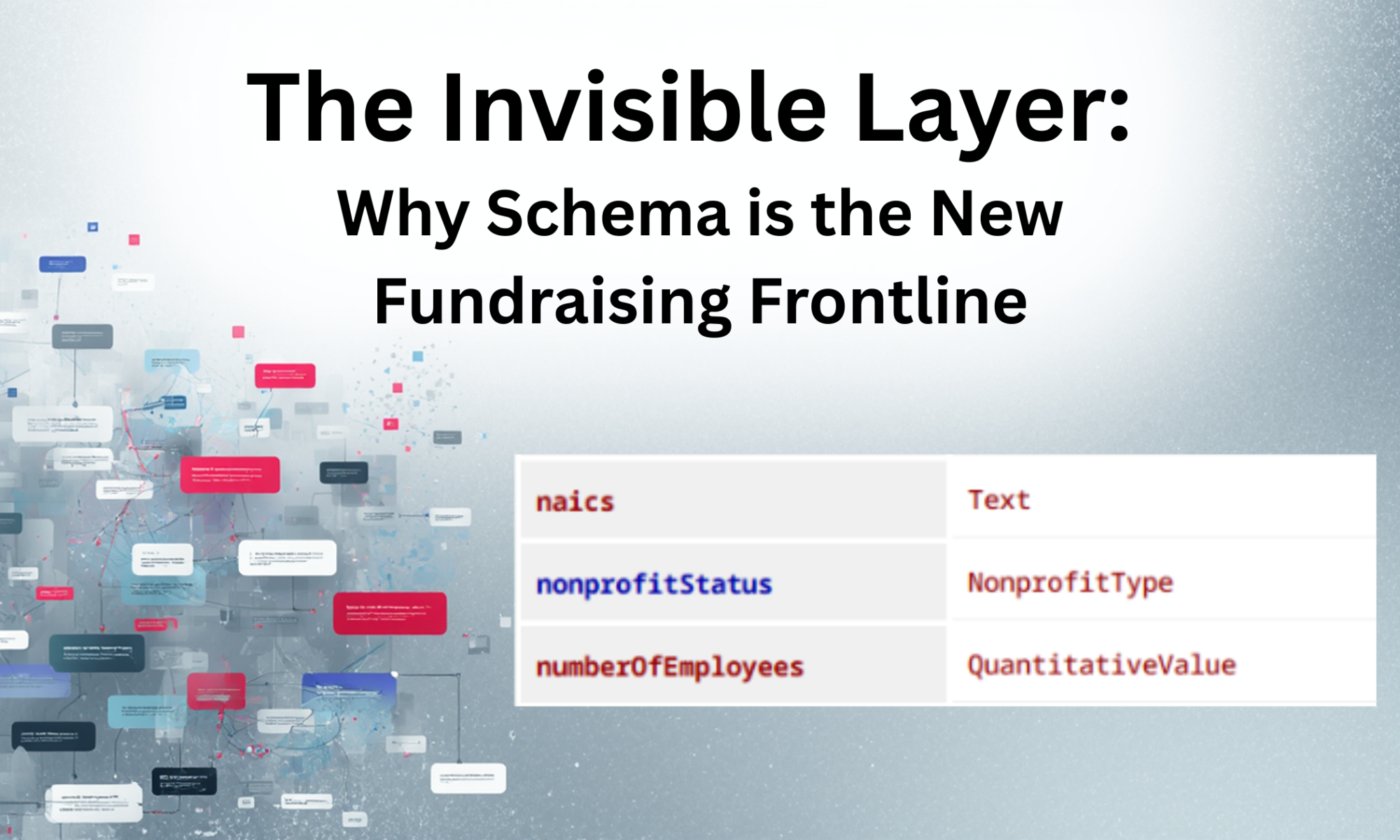
If your website is merely a collection of unstructured, emotional prose, you are practically invisible to this new paradigm. Natural Language Processing (NLP) models cannot feel your passion; they can only parse your data. This is the pivot to Answer Engine Optimization (AEO). The problem is a matter of translation. Schema markup acts as the subterranean architecture—the explicit, machine-readable scaffolding—that gives Large Language Models the context they need to confidently cite your organization as the definitive source.
II. The Blueprint: Essential Schema Types for 2026
Think of Schema markup as the technical specification sheet for your nonprofit’s soul. While your homepage tells a moving story of human triumph, your Organization Schema translates that story into a legal, verifiable taxonomy. By explicitly defining your mission, brand, and crucial nonprofitStatus properties, you are not merely bragging to a machine; you are submitting structural proof of your legitimacy. This is how you placate Google’s E-E-A-T (Experience, Expertise, Authoritativeness, and Trustworthiness) sensors, proving you are a concrete entity and not a fleeting algorithmic mirage.
Beyond the foundational identity, we must construct the load-bearing walls of engagement through Event Schema. Galas, webinars, and volunteer drives are frustratingly ephemeral unless structurally defined. By tagging your events, you allow AI assistants to proactively place your fundraisers directly into the temporal context of a donor’s calendar query.
Finally, we arrive at the modern marketer’s masterstroke: FAQ Schema. This is quite literally the “cheat code” for the AEO era. When you structure your most common donor inquiries into a machine-readable format, you are feeding the AI the exact script it needs to advocate for your cause. You bridge the gap between human curiosity and machine retrieval, ensuring that when the Oracle speaks, it speaks your name.
III. The Structural Integrity: A Technical Checklist for Leadership
There is a chronic, mildly infuriating tendency among nonprofit executives to banish technical SEO to the IT basement—treating it as a nuisance akin to fixing a jammed printer. This is a catastrophic dereliction of duty in 2026. The Subterranean Architecture requires executive oversight because it directly dictates organizational survival. The first mandate of leadership is strict Validation. You must run your digital properties through the Rich Results Test; it is not enough for the code to merely exist, it must execute flawlessly under scrutiny.
Secondly, leadership must obsess over Speed and Core Web Vitals. Google’s 2026 standards are ruthlessly focused on “Interaction to Next Paint” (INP). To an AI crawler, a sluggish website is interpreted as a crumbling foundation. If your infrastructure hesitates when a user attempts to engage, the Answer Engine will simply bypass you for a more structurally sound competitor, regardless of the nobility of your cause.
Lastly, we must address SSL and Security. In a landscape where data privacy is treated with the reverence of a state secret, a “Not Secure” warning is a structural fault line. You are asking donors for their financial data, which is an extension of their identity. Non-negotiable trust signals must be established at the protocol level. If you cannot secure the connection, you cannot be trusted with the contribution.
IV. The Masonry: Implementing JSON-LD over Microdata
When it comes to the actual application of this architecture, the industry has universally elected JSON-LD (JavaScript Object Notation for Linked Data) as the gold standard. In the dark ages of SEO, developers used Microdata—a chaotic practice of injecting inline attributes directly into the HTML, tangling your data like overgrown ivy choking a beautiful facade. JSON-LD, conversely, is clean, centralized, and sophisticated.
Sitting neatly within the <head> of your webpage, JSON-LD scripts tell a coherent, modular story to the machines without disrupting the visual experience for your human visitors. It is a parallel data layer. Implementing this does not require tearing your website down to the studs.
Whether you deploy this code via the surgical precision of Google Tag Manager or through modern CMS plugins, the process is straightforward. You are essentially pouring a new foundation beneath an existing building. By mastering this technical masonry, you guarantee that your nonprofit transcends beautiful web design, becoming a permanent, verifiable landmark in the AI-driven future.
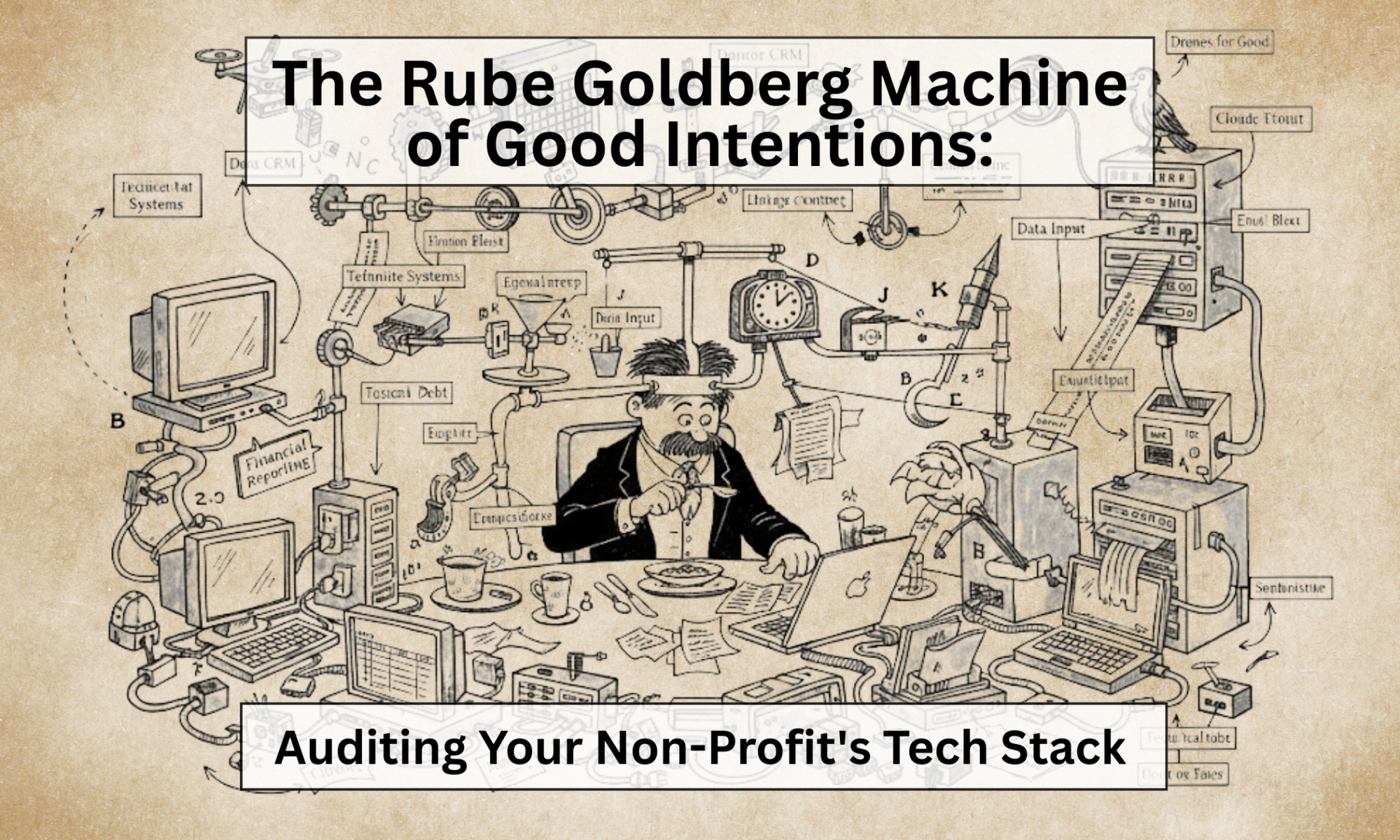
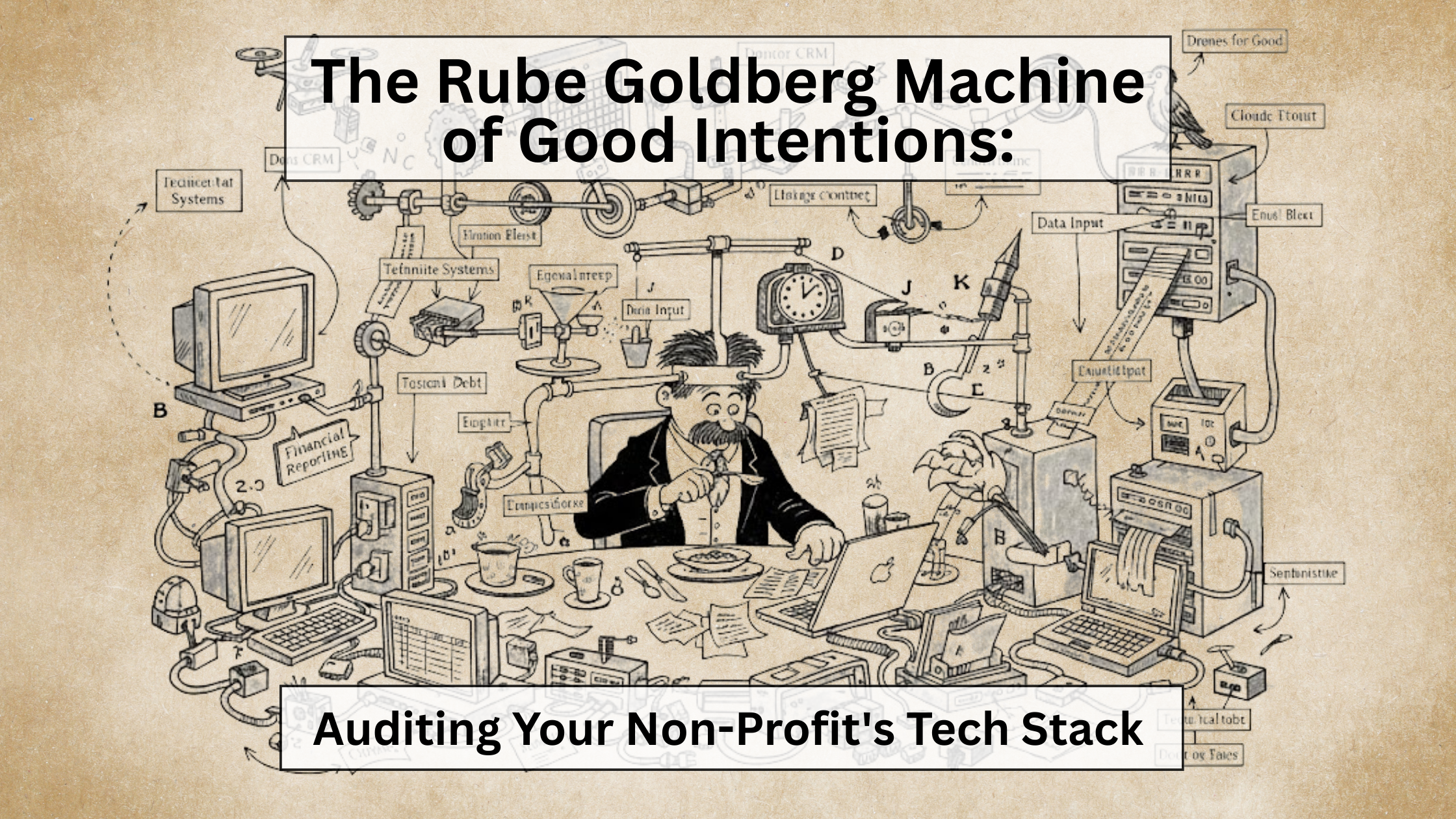
A well-meaning donor clicks “submit” on a $50 contribution, setting off a sprawling, invisible chain reaction. The digital coin drops down a chute into a siloed payment processor, which flings an unformatted email into the void, prompting a frantic development associate to manually export a spreadsheet, which ultimately triggers a mismatched, automated “Nice to meet you!” email to a benefactor who has supported your mission for a decade. This isn’t a strategy; it’s a Rube Goldberg machine of good intentions. It is an exhausting, intricate dance that eventually drops the ball, proving that a bloated technology stack isn’t merely a line-item liability—it is an active barrier to cultivating authentic human relationships.
When our systems are fractured, our empathy is inevitably compromised. Fragmented data yields a fragmented donor experience. The emotional core of philanthropy relies on recognition, continuity, and trust; chaotic software blindfolds your organization, preventing you from truly “seeing” your supporters. You cannot foster a sense of belonging when your left hand has no idea what your right hand is processing.
The imperative here is a profound psychological pivot: moving away from the reactive “tool-buyer” mentality—the desperate, ad-hoc acquisition of software to patch immediate leaks—and stepping fully into the mantle of a “Digital-First Leader.” It requires viewing your digital architecture not as a necessary evil or administrative burden, but as the very circulatory system of your mission.
Step 1: The Complete Tech Inventory
Before one can dismantle the machine, one must catalog its sprawling, chaotic components. It is deeply tempting to begin slashing software costs immediately, driven by the sheer, visceral anxiety of high administrative overhead. Yet, true organizational stewardship demands that we first document the present reality without judgment. You must establish a master ledger—a panoptic, unsentimental view of every singular tool currently occupying space in your digital ecosystem.
This inventory requires forensic precision. It is entirely insufficient to simply list “Mailchimp” and “Salesforce” on a whiteboard. A rigorous audit captures the granular, operational realities: What is the exact annual cost? When does that quiet, auto-renewing subscription trigger? More importantly, who is the actual technical steward—the lone individual who holds the metaphorical administrative keys to the kingdom?
Finally, one must confront the chasm between intention and reality by scrutinizing a tool’s primary function. What was a platform purchased to do, versus what is it actually doing? Uncovering this delta often reveals tragicomic realities: expensive, enterprise-grade software that was acquired to orchestrate complex marketing campaigns, currently being utilized merely to store a handful of static email addresses.
Step 2: Mapping the Donor Data Flow
Data silos are the silent antagonists of modern philanthropy. They are the locked, windowless rooms within your organizational architecture where valuable insights go to languish in isolation. To combat this, we must map the circulatory pathways of your information. Imagine, if you will, tracing the perilous, step-by-step journey of a single $50 online donation from inception to acknowledgment.
Does this digital token of goodwill glide effortlessly from the initial donation form, seamlessly populating your Customer Relationship Management (CRM) database, and elegantly triggering a personalized acknowledgment via your email marketing platform? Or does its journey halt abruptly, requiring the brute-force intervention of a staff member manually migrating comma-separated values (CSV) from one platform to another? Manual intervention is the friction that burns out passionate teams.
This mapping phase demands a critical interrogation of your integration middleware—the invisible translators that allow disparate software languages to communicate. Are your systems speaking fluently through native integrations built by the original developers, or do you require an Integration Platform as a Service (iPaaS)—such as Zapier or Make—to act as the diplomatic envoy between stubborn platforms? Bridging these communication gaps is paramount. Before embarking on this mapping, ensure your team is grounded in Data-Driven Fundraising Basics.
Step 3: Identify Redundancies and Low Adoption
As we audit the machinery, we must extend profound empathy to the humans tasked with operating it. When leadership discovers low adoption rates for a particular software, the knee-jerk reaction is often to blame the user’s resistance to change. However, staff members typically abandon tools not out of malice or incompetence, but because they are drowning in cognitive overload and lack adequate training. The tool may not be inherently flawed; it simply arrived without a compass or context.
To clarify this landscape, we must construct an evaluation matrix to illuminate redundancies—the digital equivalent of paying two different orchestras to play the same symphony in adjacent rooms. Are you dutifully paying a premium for a dedicated email marketing service, whilst simultaneously possessing robust, completely untapped email capabilities dormant within your primary CRM?
Consider the margins and the unseen leaks. Are exorbitant event registration fees quietly eroding the financial impact of your annual gala on a third-party ticketing site, entirely negating the fact that your existing database possesses a native, underutilized event module? Identifying these functional overlaps allows you to prune the dead branches, directing vital financial nutrients back to the core trunk of your mission.
Step 4: Consolidation and Tool Recommendations
The culmination of this audit is not merely a leaner budget spreadsheet; it is the intentional architecting of a unified system that champions the “MarTech for Good” ethos. With redundancies exposed and data pathways illuminated, the path forward branches into two distinct, strategic philosophies of consolidation.
The first is the “All-in-One Approach,” an elegant solution particularly suited for emerging or mid-sized organizations. This involves embracing unified platforms designed to synchronize fundraising, event management, and donor relations under a single, cohesive roof. Tools operating within this paradigm eliminate the need for complex digital duct tape, offering a streamlined simplicity that allows your team to focus on relationship-building rather than troubleshooting API errors.
Conversely, mature organizations with complex, multifaceted needs might favor the “Ecosystem Approach.” This philosophy anchors the digital architecture around a profoundly robust, central CRM—the undisputed, single source of truth. Any peripheral tools or third-party add-ons are then meticulously vetted for strict API compliance, ensuring they plug into the central nervous system flawlessly. Once this foundation is secure, and if your audit reveals gaps in how you speak to different supporter tiers, exploring Using AI for Donor Segmentation becomes your logical, high-impact next frontier.
I. The Efficiency Trap: When Personalization Feels Like Surveillance
The nonprofit sector in 2026 finds itself caught in a seductive, yet dangerous, mechanical embrace. We have spent the last half-decade perfecting the “High-Tech Vending Machine” model of philanthropy: the donor inserts a coin of data, and the machine—powered by a sophisticated array of AI agents—dispenses a perfectly timed, hyper-personalized “thank you” note. On paper, the metrics are dazzling. Engagement rates climb, and “automated touchpoints” proliferate like digital wildflowers. Yet, beneath the surface of this algorithmic elegance, a chilling decoupling is taking place.
When a donor receives a message that feels too engineered—knowing their dog’s name, their last three vacation spots, and their precise propensity to give on a Tuesday—the result isn’t intimacy; it is the “Uncanny Valley” of fundraising. If a donor senses that an algorithm is the only entity listening, the foundational bond of the relationship withers. We are seeing a paradoxical trend: as “automated engagement” increases by 20%, long-term brand loyalty often decays by double that amount. The machine is functioning perfectly, but the hearth has gone cold.
The shift required is a move from Predictive Analytics—which treats the donor as a variable to be solved—to Empathetic Analytics, which treats them as a partner to be understood. It is the difference between knowing what they will give and understanding why they care. In 2026, the differentiator is no longer the ability to scale; it is the courage to remain small enough to be real.
II. Pillar Focus: Leadership in the Digital-First Nonprofit
The crisis of the “Great Decoupling” is, at its heart, a crisis of governance. Current sector data reveals a staggering “Boardroom Gap”: while 80% of nonprofits have integrated AI into their daily workflows, a mere 20% have established the formal guardrails necessary to steer these digital engines. This leaves many organizations flying at Mach 1 without a compass. Leadership in 2026 demands a new competency: Data Intuition. This is the seasoned ability to look at an AI agent’s suggestion—perhaps a recommendation to prune a “low-value” donor segment—and override it based on the subtle nuances of community history or a shifting political climate.
Ethical leadership now requires the implementation of “Ethical AI Guardrails” that prioritize radical transparency over raw conversion rates. This means being honest with donors about when they are interacting with an AI and ensuring that the “Human-in-the-Loop” isn’t just a technical fail-safe, but a sacred brand asset. We must move away from the “black box” of proprietary algorithms and toward a model where the technology serves as a transparent bridge, not a decorative wall.
III. MarTech for Good: Modular, Not Monolithic
The architectural solution to this decoupling lies in a rejection of the “all-in-one” monolithic platforms that promised simplicity but delivered rigidity. In 2026, the agile nonprofit utilizes a modular, API-driven stack. This approach allows organizations to swap components as privacy laws evolve and donor expectations shift. A foundational data backbone (as explored in our Data-Driven Fundraiser’s Toolkit) ensures that while the tools may change, the integrity of the donor’s story remains intact.
Furthermore, we must satisfy the “Show Me” generation—a donor class that demands real-time validation of their impact. By utilizing a unified data model (see our MarTech Stack Audit Guide), organizations can connect back-end CRM data directly to front-end impact visualizations. This isn’t just about efficiency; it’s about using technology to rebuild the “Community Hearth.” When a donor can see the immediate ripple effect of their contribution, the tech stack ceases to be a vending machine and becomes a window into the mission’s soul.
IV. Conclusion: Returning to the Hearth
As we navigate the remainder of 2026, the nonprofits that thrive will be those that realize technology is a magnificent servant but a horrific master. We cannot automate our way into a movement; we cannot optimize our way into a community. The “Great Decoupling” is a warning shot for leaders who have traded the warmth of human connection for the cold precision of the machine.
True “Digital Transformation” isn’t about how many AI agents you can deploy; it’s about how much time those agents can buy your staff to do the “human work”—the phone calls, the shared coffees, and the deep, messy listening that no LLM can replicate. By reclaiming the Human-in-the-Loop, we move away from the transactional vending machine and back toward the communal hearth, where trust is stoked, not just calculated.
Okay, Director of Marketing, let’s be honest. Some days, doesn’t your job feel less like strategic leadership and more like a chaotic circus act? You’re juggling flaming torches (new campaigns), spinning plates (social media), taming lions (competitor analysis), and trying to sell popcorn (actually, you know, your products/services) – all while keeping a smile plastered on your face for the audience (your CEO and sales team). It’s a lot.
What if I told you there’s a way to not just get more hands, but super-powered, intelligent, and endlessly energetic ones? Enter AI agentic workflows, your new favorite behind-the-scenes crew.
Think of yourself as the Ringmaster of this incredible marketing circus. You’ve got the vision, the strategy, the understanding of what wows the crowd. But instead of desperately trying to train a troupe of well-meaning but sometimes fumbling human assistants for every single task, you now have access to a team of highly specialized AI agents.
What in the Big Top are AI Agentic Workflows?
Imagine this: you need to launch a new product. Instead of manually briefing a writer, then a designer, then a social media manager, then an ads specialist, all while chasing approvals and collating feedback, you deploy an AI agentic workflow.
Your “Scout” Agent: This AI whiz kid dives deep into market research, competitor messaging, and current trends with lightning speed. It uncovers insights you’d spend weeks digging for, identifying the perfect audience and the watering holes where they congregate online.
Your “Wordsmith” Agent: Armed with the Scout’s intel, this agent drafts compelling ad copy, blog posts, email sequences, and social media captions, all tailored to different platforms and audience segments. It can even A/B test headlines faster than a speeding trapeze artist.
Your “Visionary” Agent: Need visuals? This AI can generate mood boards, suggest imagery, or even create initial design mockups for your campaigns, giving your human designers a fantastic head start.
Your “Scheduler” Agent: This ultra-organized agent takes all that brilliant content and schedules it across all your chosen platforms, ensuring optimal timing and reach. No more missed posts or frantic last-minute scrambles.
Your “Analyst” Agent: As the campaign runs, this agent diligently tracks performance metrics in real-time. It doesn’t just report numbers; it spots trends, identifies what’s resonating (and what’s flopping), and even suggests optimizations. It’s like having a data scientist who never sleeps and speaks plain English.
From Juggling Chainsaws to Conducting an Orchestra
With AI agentic workflows, you, the Marketing Director, transition from a stressed-out, multi-tasking juggler to a strategic conductor.
Be More Efficient? Absolutely. Repetitive, time-consuming tasks get automated. Your team is freed up from the grunt work to focus on higher-level strategy, creative brainstorming, and building those crucial human connections. Think of the hours reclaimed!
Be More Effective? You Bet. These AI agents are data-driven. They learn, adapt, and optimize based on real-time feedback. This means campaigns that hit harder, resonate deeper, and deliver better ROI. No more throwing spaghetti at the wall and hoping it sticks.
Achieve Pinpoint Personalization? It’s Here. Imagine crafting hyper-personalized customer journeys at scale. AI agents can help segment audiences with incredible granularity and tailor messaging accordingly, making your audience feel truly seen and understood.
Boost Creativity? Surprisingly, Yes! By handling the mundane, AI workflows free up your team’s brainpower for innovation. Plus, the insights and starting points generated by AI can actually spark new creative avenues you hadn’t considered.
Make Smarter Decisions, Faster? That’s the Goal. With comprehensive data and intelligent analysis at your fingertips, you can make informed strategic decisions with greater confidence and speed. No more gut feelings disguised as strategy.
The Future Isn’t Scary, It’s Efficient
Adopting AI agentic workflows isn’t about replacing your talented human team; it’s about augmenting them, empowering them to do their best work. It’s about transforming your marketing department from a frantic flurry of activity into a well-oiled, strategic powerhouse.
So, are you ready to put down the juggling chainsaws and pick up the conductor’s baton? It’s time to let AI agentic workflows help you orchestrate your most successful marketing performances yet. The crowd is waiting.
In the vast digital landscape, educational institutions must stand out to attract the right audience. One of the most effective ways to enhance online visibility is through schema markup. If you’re a higher education marketing professional or decision maker, this guide will help you understand and implement schema markup to improve your website’s SEO.
Understanding Schema Markup Basics
Brief History of Schema.org
Founded in 2011 by major search engines like Google, Bing, Yahoo, and Yandex, Schema.org aims to create a structured data vocabulary that improves search engine understanding of web content. This collaboration has significantly enhanced how search engines interpret and display information.
Relationship Between Search Engines and Schema Markup
Schema markup helps search engines understand the context and relevance of your website’s content. This, in turn, leads to more accurate and rich search results, increasing your visibility and click-through rates (CTR).
Overview of Microdata, RDFa, and JSON-LD
Microdata and RDFa (Resource Description Framework in Attributes) embed metadata within HTML content.
JSON-LD (JavaScript Object Notation for Linked Data) is a popular format for its simplicity and compatibility with JavaScript.
The Importance of Schema Markup for Educational Institutions
Enhancing Search Engine Results Through Rich Snippets
Rich snippets display additional information like star ratings, event dates, and course details directly in search results, making your listings more attractive and informative.
Increasing Click-Through Rates
With rich snippets, your search result stands out, leading to higher CTR and more engagement.
Improving Local SEO and Event Visibility
Schema markup can also optimize your local SEO, making it easier for prospective students and parents to find you.
Establishing Authority and Trustworthiness
Providing detailed, structured data enhances your institution’s authority and credibility in the eyes of search engines and users alike.
Common Schema Types for Educational Websites
Schools & Colleges
Educational Organization: General schema for educational institutions.
CollegeOrUniversity and School (ElementarySchool, MiddleSchool, HighSchool): Specific schemas for different education levels.
Courses
Course Schema Type: Provides detailed information about individual courses.
Events
EducationEvent: Highlights educational events like workshops, seminars, and lectures.
People
Person Schema: Useful for faculty and alumni profiles, showcasing their achievements and qualifications.
Step-by-step Implementation Guide
Choosing the Right Schema Type
Identify the schema types that best represent your content, such as `EducationalOrganization` for your institution or `Course` for individual courses.
Implementing Using JSON-LD
JSON-LD is the recommended format for implementing schema markup as it is easy to read and flexible.
Placement of Schema Code
Place the JSON-LD code in the `<head>` section of your HTML document or use a tag manager.
Testing and Validation
Use tools like Google’s Rich Results Test and Schema.org’s Validator to ensure your markup is correctly implemented.
Integrating Schema Markup with Your Content Strategy
Crafting Content with Schema in Mind
Create content that aligns with your schema markup to ensure consistency and relevance.
Aligning Technical SEO and Content Creation
Work closely with your technical team to seamlessly integrate schema markup into your overall content strategy.
Advanced Schema Implementation Strategies
Dynamic Schema Markup for Frequently Updated Content
For content that changes frequently, such as event listings, use dynamic schema markup to keep your data current.
Leveraging Schema for Improved Analytics and Insight
Schema markup can enhance your analytics by providing more detailed insights into user behavior and search performance.
Continual Optimization and Monitoring
Regularly update and refine your schema markup based on the latest guidelines and search engine updates.
Advanced Tips for Optimizing Schema Markup
Harnessing the Power of Nested Schema Markup
Use nested schema to provide more context and detail, enhancing the richness of your data.
Semantic Relationships and Linked Data
Leverage semantic relationships and linked data to create a more interconnected and informative web presence.
Schema Markup for Multimedia Content
Optimize video and image content with relevant schema markup to boost visibility and engagement.
Personalization Through Schema Markup
Use schema to personalize content and improve user experience by tailoring information to individual preferences.
Collaborative Schema Development and Sharing
Building a Community of Practice
Collaborate with other educational institutions to share best practices and innovations in schema markup.
Contributing to Schema.org
Participate in the Schema.org community to stay updated and contribute to the development of new schemas.
Potential Pitfalls and How to Avoid Them
Ensuring Authenticity in Your Schema Markup
Accurate and honest schema markup is crucial to maintaining trust and avoiding penalties from search engines.
Balancing Detail with Clarity
Provide enough detail to be informative without overwhelming users or search engines.
Adapting to Search Engine Algorithm Changes
Stay informed about algorithm updates and adjust your schema markup accordingly.
Addressing Schema Markup Implementation Errors
Regularly audit your markup to identify and correct any errors.
Tools to Assist with Schema Markup Implementation
Here are some tools that will help you with your schema goals:
Google’s Structured Data Markup Helper Google’s Structured Data Markup Helper is a tool that assists webmasters in adding structured data markup to their websites, making it easier for search engines to understand and display the content.
Google’s Rich Results Test is a tool that evaluates your website’s structured data to determine if it qualifies for rich results in Google’s search engine, helping to enhance your site’s visibility and user engagement.
Schema.org’s Official Documentation is a comprehensive resource that provides guidelines, examples, and detailed information on using structured data markup to improve search engine understanding and visibility of web content.
Merkle’s Schema Markup Generator is a tool that helps users create and customize structured data markup for their websites, enhancing SEO and search engine visibility.
Bing’s Markup Validatoris a tool that checks the structured data markup on your website to ensure it adheres to Bing’s guidelines and standards, helping to improve your site’s search engine optimization.
Schema Markup and The Future of SEO for Educational Websites
Embracing the Semantic Web
Adopt semantic technologies to create a more connected and meaningful web experience.
Crafting a Richer Web of Information
Utilize advanced schema techniques to enrich the information available on your website.
Pioneering with New Schema Types
Stay ahead of the curve by experimenting with new and emerging schema types.
Leveraging Schema Markup for Emerging Technologies
Integrate schema with cutting-edge technologies like AI and machine learning for enhanced functionality.
Preparing for Voice Search Dominance
Optimize your schema markup for voice search to stay relevant in the evolving search landscape.
Integrating with AI and Machine Learning
Use AI to automate and improve your schema markup processes.
Fostering an Ecosystem of Shared Learning
Encourage collaboration and knowledge sharing within the educational community.
Using AI in Your Schema Markup Strategy
Artificial Intelligence (AI) can significantly streamline the process of writing schema markup code for website managers, making it more efficient and less prone to errors. Here’s how AI can assist in this task:
1. Automated Schema Generation
AI tools can automatically generate schema markup based on the content of a webpage. By analyzing the text, images, and other elements on the page, AI can determine the most appropriate schema types (e.g., Article, Product, Event) and generate the corresponding JSON-LD or Microdata code.
2. Content Analysis and Classification
AI can analyze the structure and content of a webpage to classify different types of information (e.g., names, dates, locations). This helps in identifying which schema properties should be used and ensures that all relevant information is marked up accurately.
3. Natural Language Processing (NLP)
Using NLP, AI can understand and extract key information from the text. For example, it can identify an event’s date, location, and organizer from a description and use this data to create a complete Event schema markup.
4. Integration with Content Management Systems (CMS)
AI-powered plugins or extensions can be integrated with popular CMS platforms like WordPress, Joomla, or Drupal. These tools can provide real-time suggestions and automatically insert schema markup as the website manager creates or edits content.
5. Schema Markup Suggestions
AI tools can offer schema markup suggestions based on best practices and the latest SEO trends. This ensures that the website uses the most effective and up-to-date schema types and properties, enhancing search engine visibility and user engagement.
6. Error Detection and Correction
AI can detect errors or missing fields in existing schema markup and provide recommendations for corrections. This helps maintain the accuracy and completeness of the structured data, ensuring better performance in search engine results.
7. Continuous Learning and Adaptation
AI systems can continuously learn from changes in search engine algorithms and user behavior. They can adapt their schema generation strategies to align with the latest SEO guidelines and improve the website’s search engine ranking over time.
Example Workflow
Here’s an example workflow you may want to consider:
Content Input: The website manager inputs the content (e.g., a new blog post, product page).
AI Analysis: The AI analyzes the content to understand its structure and extract relevant information.
Schema Generation: Based on the analysis, the AI generates the appropriate schema markup code.
Review and Edit: The website manager reviews the generated code and makes any necessary adjustments.
Implementation: The AI tool automatically inserts the schema markup into the webpage’s HTML.
Schema App: An AI-driven platform that offers automated schema markup generation and management.
WordLift: A WordPress plugin that uses AI to generate and manage schema markup.
AI can greatly simplify the process of creating and managing schema markup, making it accessible even to those with limited technical expertise. By automating schema generation, providing intelligent suggestions, and ensuring compliance with SEO best practices, AI empowers website managers to enhance their site’s visibility and user experience efficiently.
In Conclusion
In the digital age, where information overload is common, standing out is both an art and a science. For educational websites, schema markup has become a necessity. As institutions aim to connect with potential students, faculty, or donors, this structured data acts as a beacon, guiding users to the most relevant and impactful content.
However, it’s important to use schema markup judiciously and in conjunction with other SEO strategies. The ultimate goal is to provide value, foster trust, and create an enriching digital experience for all users.
Whether you’re an established educational institution or a budding e-learning platform, the digital realm offers limitless potential. Let schema markup be your compass, guiding you toward enhanced visibility, engagement, and success.
Artificial Intelligence (AI) is revolutionizing the landscape of higher education marketing, providing tools that streamline the creation and distribution of content. To harness these tools effectively, it’s crucial to understand their potential and how to implement them strategically.
Understanding AI-Generated Content
AI-generated content refers to materials produced by AI algorithms, such as written articles, marketing copy, and visuals. These algorithms can analyze data patterns and generate content with minimal human intervention, enhancing efficiency and consistency in content creation.
In the context of higher education, AI-generated content includes automated marketing materials, course descriptions, personalized student communications, and engagement tools. Universities and colleges use these strategies to create a lasting impression on prospective students.
Key Benefits of AI in Higher Education Marketing
Incorporating AI into higher education marketing strategies presents a myriad of benefits, fundamentally reshaping how institutions engage with their target audience. These advantages include the ability to tailor communication for more effective engagement, analyze data to refine marketing strategies, ensure content resonates with diverse demographics, and provide automated assistance through intelligent chatbots. Let’s explore these key benefits in detail:
AI’s integration into higher education marketing offers several advantages:
Personalized Communication: AI tailors messages to engage prospective students effectively.
Data Analysis: AI analyzes trends and behaviors to optimize marketing strategies.
Content Delivery: AI ensures content resonates with diverse audiences through targeted delivery.
Automated Assistance: AI-driven chatbots provide instant information, guiding students through the application process and answering queries.
Types of AI-Generated Content
The integration of AI technology in higher education marketing enables the creation of diverse and engaging content types. These include visually appealing graphics and images, interactive formats that encourage user participation, automated generation of social media posts, and optimized content for landing pages and blogs. Additionally, AI facilitates the personalization of email campaigns based on user data, as well as the development of immersive virtual tours. Compelling course descriptions further enhance the overall marketing strategy, capturing the attention of prospective students and encouraging further exploration.
Higher education marketers can utilize various forms of AI-generated content, including:
Visual Content: Graphics and images created by AI enhance visual appeal.
Interactive Content: Engaging formats that encourage user interaction.
Social Media Posts: Automated generation of posts for social media platforms.
Landing Pages and Blog Posts: Content optimized for engagement and SEO.
Email Campaigns: Personalized email content based on user data.
Virtual Tours: AI-powered tours that provide an immersive campus experience.
Course Descriptions: Compelling descriptions get prospects to read more.
Developing an AI-Generated Content Strategy
AI has the power to revolutionize content creation. The key to unlocking valuable AI-generated content lies in using the right prompts. Properly framing these prompts and utilizing the tools effectively is crucial.
When developing AI marketing strategies for higher education, keep the following components in mind:
Setting Clear Objectives and Goals
AI serves as a powerful tool, but it’s not a standalone solution. To utilize it effectively, you need clear objectives and goals to engage your audience. Determine whether you want AI to help generate ideas, create written content, produce images, or develop videos for your marketing campaigns. AI can also assist in repurposing existing content and optimizing it for SEO, enhancing your marketing and promotional efforts.
When defining your objectives and goals, consider the following:
Outline Desired Outcomes: Clearly specify the knowledge and skills students should acquire.
Set Quality Benchmarks: Establish standards for content quality to meet educational criteria.
Align Content with Goals: Ensure that AI-generated content supports your defined objectives.
Implement Feedback Loops: Regularly refine and improve AI-generated content based on feedback.
Address Ethical Concerns: Maintain academic integrity by addressing ethical considerations.
Understanding your purpose and the specific achievements you seek through AI-generated content is crucial.
Understanding the Target Audience
Knowing your target audience is vital for creating effective content in higher education. Tailoring content to students’ needs, preferences, and academic goals boosts engagement and enhances learning outcomes.
To understand your target audience for higher education marketing using AI tools, consider:
Demographic Analysis: Study the demographic characteristics of your audience.
Prior Knowledge Levels: Assess the existing knowledge base of your audience.
Learning Preferences: Identify how your audience prefers to learn.
Cultural Diversity: Recognize and respect cultural differences within your audience.
Language Proficiency: Account for varying levels of language skills.
Technological Familiarity: Gauge your audience’s comfort with technology.
Academic Goals: Understand the educational aspirations of your audience.
This comprehensive understanding ensures that your educational materials are relevant, accessible, and resonate with the diverse needs of the student body, thereby enhancing your lead generation efforts in higher education marketing.
Selecting the Right AI Tools and Platforms
AI tools allow knowledge workers to analyze data, make predictions, and perform tasks more efficiently. Before investing in an AI platform, consider these key factors:
Flexibility and Compatibility: Ensure the tool integrates smoothly with your existing systems.
Scalability: Look for tools that can handle deep learning and grow with your needs.
Budget: Make sure the cost aligns with your financial constraints.
Algorithms and Optimization: Choose tools with powerful algorithms and optimization capabilities.
Security and Compliance: Ensure robust security measures and regulatory compliance.
Pre-Built APIs: Look for tools with pre-built cognitive APIs to speed up implementation.
Third-Party Integration: Verify that the tool integrates with other platforms you use.
Customized Support: Opt for tools that offer tailored support services.
Transparent Pricing: Seek clear and straightforward pricing models.
Trial Period: Test the platform before committing to a purchase.
Consider your project’s specific needs, the learning curve, and future planning when selecting an AI platform.
Content Creation and Curation
In higher education marketing, effective content creation and curation are essential for attracting and retaining students. Tailor your content to highlight academic excellence, campus life, and career opportunities to engage prospective students.
Strategies include:
Creating Compelling Content: Develop blog posts, videos, and social media content that showcase unique aspects of your institution.
Curating Existing Content: Select and organize existing materials to build credibility and authority. A well-executed strategy positions your institution as a thought leader and fosters trust.
Writing AI-Generated Articles:
Use AI algorithms to generate written content. Leverage natural language processing to create coherent, contextually relevant articles, saving time and enhancing productivity.
Creating AI-Generated Visuals:
Utilize AI to generate images, graphics, or multimedia content. This enhances visual appeal and supports communication, ensuring efficiency and creativity in visual representation.
Quality Control and Human Oversight
In higher education content generation, quality control and human oversight are crucial. Human oversight is necessary to review, refine, and correct AI-generated content, ensuring it aligns with academic integrity.
Establish rigorous quality standards to maintain accuracy and meet educational objectives. This process helps mitigate biases, ethical issues, and content inaccuracies, balancing technological capabilities with human expertise.
As a higher-education marketer, it’s essential to ensure your content resonates with the target audience and meets high standards of relevance, reliability, and educational efficacy. Additionally, AI can suggest various methods and strategies to personalize your content effectively.
Ensuring Compliance and Ethical Considerations
While AI can boost productivity and creativity in higher education, it also raises ethical questions, such as the implications of machines mimicking human creativity and authorship.
Reliability and accuracy are paramount when using AI content-generation tools. Since these tools depend on algorithms and machine learning, there’s a risk of producing false or misleading information. Regular updates and rigorous testing can improve the reliability and accuracy of AI-generated content.
Ethical considerations for using AI content tools in higher education include:
Transparency, Disclosure, and Accountability: Clearly communicate the use of AI and be accountable for its outputs.
Data Privacy and Protection: Safeguard personal information used by AI tools.
Social and Cultural Implications: Be mindful of the social and cultural impact of AI-generated content.
Copyright Laws and Fair Use Doctrine: Adhere to copyright regulations and ensure fair use.
Plagiarism and Copyright Infringement: Avoid plagiarism and respect intellectual property rights.
Proper Attribution and Citation: Accurately attribute sources and provide proper citations.
By following industry standards and best practices, AI tools can achieve higher accuracy and reliability, enhancing their overall value.
Implementing an AI-Generated Content Strategy
Integrating an AI-generated content strategy in higher education marketing requires seamless coordination with existing efforts to boost engagement and communication. By utilizing AI to create customized content for diverse audiences, institutions can deliver personalized messages that resonate with prospective students, faculty, and stakeholders.
To refine strategies, it is crucial to measure and evaluate the performance of AI-generated content. Employing key performance indicators (KPIs) such as engagement rates, conversion metrics, and audience feedback ensures a data-driven approach. Continuous improvement and optimization, driven by analytics, allow higher education marketers to adapt dynamically, maintaining relevance and impact.
The Future of AI in Higher Education Marketing
AI is set to elevate higher education marketing strategies to new heights. Its future is multifaceted, addressing everything from personalized learning to operational efficiency. AI tools play a significant role in creating adaptive learning programs tailored to each student’s needs.
Personalized Learning Paths: Combining digital marketing with AI-generated content allows for educational materials tailored to individual needs, enhancing engagement and performance by offering a customized learning experience.
Chatbots for Student Support: AI-powered chatbots assist prospective and current students with inquiries, applications, and general support. They provide instant responses, improving efficiency and enhancing the overall student experience.
Predictive Analytics for Student Success: Utilizing machine learning algorithms, institutions can predict factors affecting student success, identifying at-risk students early. This proactive approach enables targeted interventions, improving retention rates and overall academic outcomes.
Final Thoughts
AI is revolutionizing higher education by employing data-driven strategies that engage students and enhance their academic journey. It disrupts administrative, teaching, learning, and research activities, transforming the future of education.
In higher ed marketing, an AI-generated content strategy not only improves outreach but also personalizes it, boosting student recruitment and enrollment. Understanding prospects more deeply allows for a nuanced grasp of their behavior, preferences, and needs.
By embracing AI, higher education institutions can leverage its potential for improvement across the board. With guidance from higher education marketing consultants, AI can help tailor lesson plans, assessments, and overall student experiences, driving significant advancements in education.