
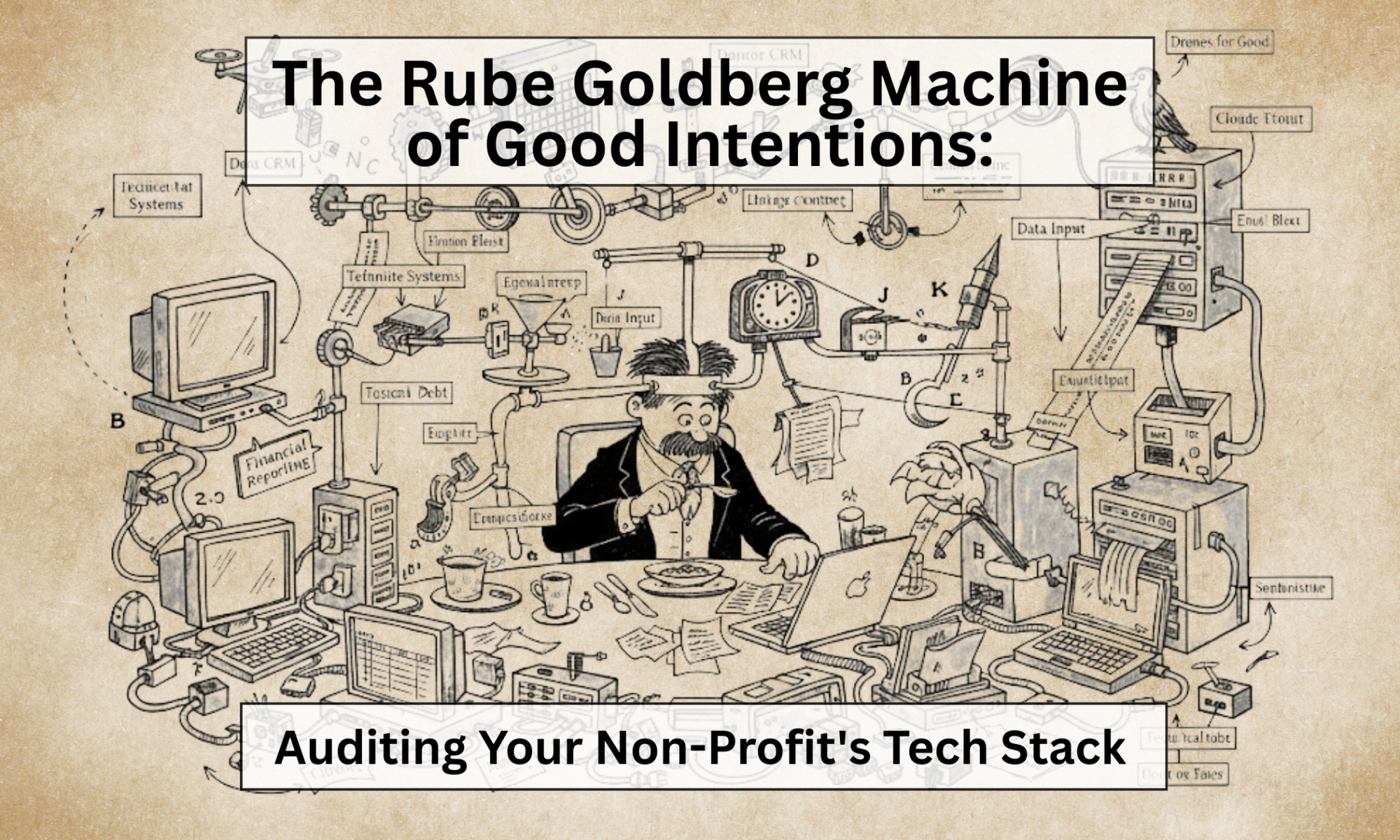
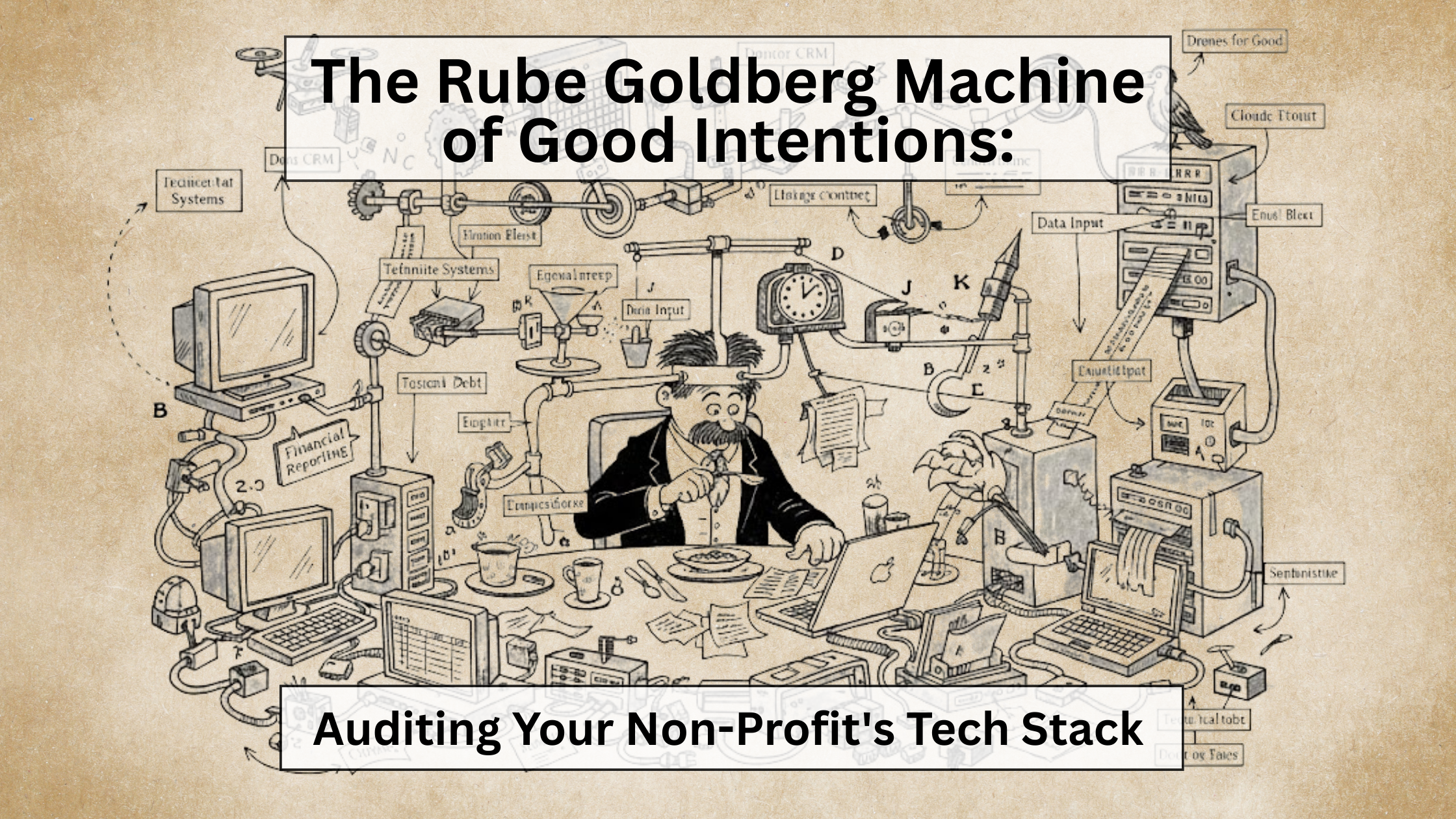
A well-meaning donor clicks “submit” on a $50 contribution, setting off a sprawling, invisible chain reaction. The digital coin drops down a chute into a siloed payment processor, which flings an unformatted email into the void, prompting a frantic development associate to manually export a spreadsheet, which ultimately triggers a mismatched, automated “Nice to meet you!” email to a benefactor who has supported your mission for a decade. This isn’t a strategy; it’s a Rube Goldberg machine of good intentions. It is an exhausting, intricate dance that eventually drops the ball, proving that a bloated technology stack isn’t merely a line-item liability—it is an active barrier to cultivating authentic human relationships.
When our systems are fractured, our empathy is inevitably compromised. Fragmented data yields a fragmented donor experience. The emotional core of philanthropy relies on recognition, continuity, and trust; chaotic software blindfolds your organization, preventing you from truly “seeing” your supporters. You cannot foster a sense of belonging when your left hand has no idea what your right hand is processing.
The imperative here is a profound psychological pivot: moving away from the reactive “tool-buyer” mentality—the desperate, ad-hoc acquisition of software to patch immediate leaks—and stepping fully into the mantle of a “Digital-First Leader.” It requires viewing your digital architecture not as a necessary evil or administrative burden, but as the very circulatory system of your mission.
Step 1: The Complete Tech Inventory
Before one can dismantle the machine, one must catalog its sprawling, chaotic components. It is deeply tempting to begin slashing software costs immediately, driven by the sheer, visceral anxiety of high administrative overhead. Yet, true organizational stewardship demands that we first document the present reality without judgment. You must establish a master ledger—a panoptic, unsentimental view of every singular tool currently occupying space in your digital ecosystem.
This inventory requires forensic precision. It is entirely insufficient to simply list “Mailchimp” and “Salesforce” on a whiteboard. A rigorous audit captures the granular, operational realities: What is the exact annual cost? When does that quiet, auto-renewing subscription trigger? More importantly, who is the actual technical steward—the lone individual who holds the metaphorical administrative keys to the kingdom?
Finally, one must confront the chasm between intention and reality by scrutinizing a tool’s primary function. What was a platform purchased to do, versus what is it actually doing? Uncovering this delta often reveals tragicomic realities: expensive, enterprise-grade software that was acquired to orchestrate complex marketing campaigns, currently being utilized merely to store a handful of static email addresses.
Step 2: Mapping the Donor Data Flow
Data silos are the silent antagonists of modern philanthropy. They are the locked, windowless rooms within your organizational architecture where valuable insights go to languish in isolation. To combat this, we must map the circulatory pathways of your information. Imagine, if you will, tracing the perilous, step-by-step journey of a single $50 online donation from inception to acknowledgment.
Does this digital token of goodwill glide effortlessly from the initial donation form, seamlessly populating your Customer Relationship Management (CRM) database, and elegantly triggering a personalized acknowledgment via your email marketing platform? Or does its journey halt abruptly, requiring the brute-force intervention of a staff member manually migrating comma-separated values (CSV) from one platform to another? Manual intervention is the friction that burns out passionate teams.
This mapping phase demands a critical interrogation of your integration middleware—the invisible translators that allow disparate software languages to communicate. Are your systems speaking fluently through native integrations built by the original developers, or do you require an Integration Platform as a Service (iPaaS)—such as Zapier or Make—to act as the diplomatic envoy between stubborn platforms? Bridging these communication gaps is paramount. Before embarking on this mapping, ensure your team is grounded in Data-Driven Fundraising Basics.
Step 3: Identify Redundancies and Low Adoption
As we audit the machinery, we must extend profound empathy to the humans tasked with operating it. When leadership discovers low adoption rates for a particular software, the knee-jerk reaction is often to blame the user’s resistance to change. However, staff members typically abandon tools not out of malice or incompetence, but because they are drowning in cognitive overload and lack adequate training. The tool may not be inherently flawed; it simply arrived without a compass or context.
To clarify this landscape, we must construct an evaluation matrix to illuminate redundancies—the digital equivalent of paying two different orchestras to play the same symphony in adjacent rooms. Are you dutifully paying a premium for a dedicated email marketing service, whilst simultaneously possessing robust, completely untapped email capabilities dormant within your primary CRM?
Consider the margins and the unseen leaks. Are exorbitant event registration fees quietly eroding the financial impact of your annual gala on a third-party ticketing site, entirely negating the fact that your existing database possesses a native, underutilized event module? Identifying these functional overlaps allows you to prune the dead branches, directing vital financial nutrients back to the core trunk of your mission.
Step 4: Consolidation and Tool Recommendations
The culmination of this audit is not merely a leaner budget spreadsheet; it is the intentional architecting of a unified system that champions the “MarTech for Good” ethos. With redundancies exposed and data pathways illuminated, the path forward branches into two distinct, strategic philosophies of consolidation.
The first is the “All-in-One Approach,” an elegant solution particularly suited for emerging or mid-sized organizations. This involves embracing unified platforms designed to synchronize fundraising, event management, and donor relations under a single, cohesive roof. Tools operating within this paradigm eliminate the need for complex digital duct tape, offering a streamlined simplicity that allows your team to focus on relationship-building rather than troubleshooting API errors.
Conversely, mature organizations with complex, multifaceted needs might favor the “Ecosystem Approach.” This philosophy anchors the digital architecture around a profoundly robust, central CRM—the undisputed, single source of truth. Any peripheral tools or third-party add-ons are then meticulously vetted for strict API compliance, ensuring they plug into the central nervous system flawlessly. Once this foundation is secure, and if your audit reveals gaps in how you speak to different supporter tiers, exploring Using AI for Donor Segmentation becomes your logical, high-impact next frontier.