
I. The Shift from SEO to AEO: The Death of the Digital Library
For the better part of two decades, nonprofit digital strategy was built on the logic of a public library. You organized your content, optimized your keywords, and trusted that a diligent researcher—the prospective donor—would eventually find you in the stacks. But in 2026, the library has been razed to make way for the Oracle. Donors are no longer passively “searching” through pages of blue links; they are “asking” AI assistants to curate their reality. They aren’t typing “best clean water charities.” They are demanding of their devices: “Find me a highly rated, transparent NGO working in Sub-Saharan Africa where my $50 monthly donation makes a verified impact.”
If your website is merely a collection of unstructured, emotional prose, you are practically invisible to this new paradigm. Natural Language Processing (NLP) models cannot feel your passion; they can only parse your data. This is the pivot to Answer Engine Optimization (AEO). The problem is a matter of translation. Schema markup acts as the subterranean architecture—the explicit, machine-readable scaffolding—that gives Large Language Models the context they need to confidently cite your organization as the definitive source.
II. The Blueprint: Essential Schema Types for 2026
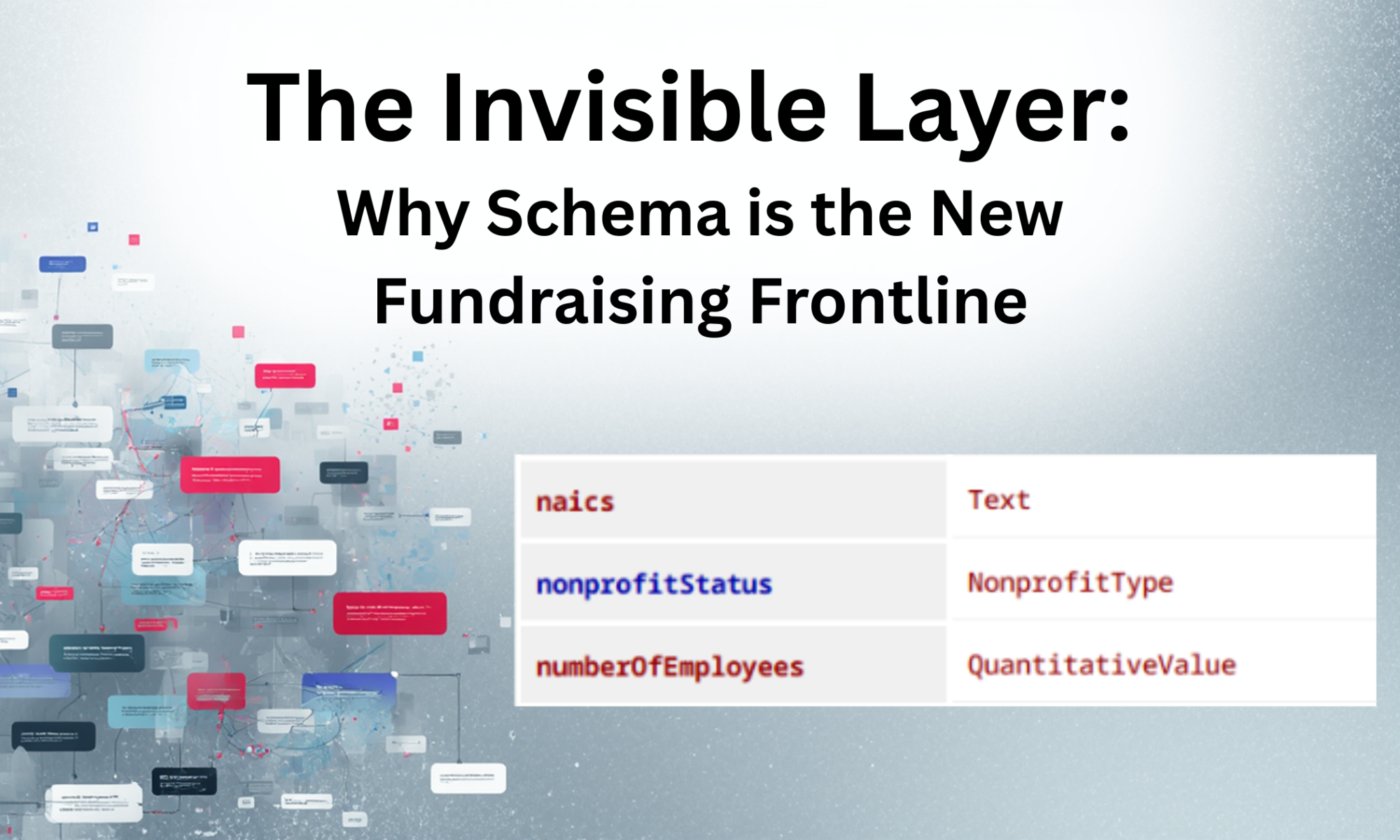
Think of Schema markup as the technical specification sheet for your nonprofit’s soul. While your homepage tells a moving story of human triumph, your Organization Schema translates that story into a legal, verifiable taxonomy. By explicitly defining your mission, brand, and crucial nonprofitStatus properties, you are not merely bragging to a machine; you are submitting structural proof of your legitimacy. This is how you placate Google’s E-E-A-T (Experience, Expertise, Authoritativeness, and Trustworthiness) sensors, proving you are a concrete entity and not a fleeting algorithmic mirage.
Beyond the foundational identity, we must construct the load-bearing walls of engagement through Event Schema. Galas, webinars, and volunteer drives are frustratingly ephemeral unless structurally defined. By tagging your events, you allow AI assistants to proactively place your fundraisers directly into the temporal context of a donor’s calendar query.
Finally, we arrive at the modern marketer’s masterstroke: FAQ Schema. This is quite literally the “cheat code” for the AEO era. When you structure your most common donor inquiries into a machine-readable format, you are feeding the AI the exact script it needs to advocate for your cause. You bridge the gap between human curiosity and machine retrieval, ensuring that when the Oracle speaks, it speaks your name.
III. The Structural Integrity: A Technical Checklist for Leadership
There is a chronic, mildly infuriating tendency among nonprofit executives to banish technical SEO to the IT basement—treating it as a nuisance akin to fixing a jammed printer. This is a catastrophic dereliction of duty in 2026. The Subterranean Architecture requires executive oversight because it directly dictates organizational survival. The first mandate of leadership is strict Validation. You must run your digital properties through the Rich Results Test; it is not enough for the code to merely exist, it must execute flawlessly under scrutiny.
Secondly, leadership must obsess over Speed and Core Web Vitals. Google’s 2026 standards are ruthlessly focused on “Interaction to Next Paint” (INP). To an AI crawler, a sluggish website is interpreted as a crumbling foundation. If your infrastructure hesitates when a user attempts to engage, the Answer Engine will simply bypass you for a more structurally sound competitor, regardless of the nobility of your cause.
Lastly, we must address SSL and Security. In a landscape where data privacy is treated with the reverence of a state secret, a “Not Secure” warning is a structural fault line. You are asking donors for their financial data, which is an extension of their identity. Non-negotiable trust signals must be established at the protocol level. If you cannot secure the connection, you cannot be trusted with the contribution.
IV. The Masonry: Implementing JSON-LD over Microdata
When it comes to the actual application of this architecture, the industry has universally elected JSON-LD (JavaScript Object Notation for Linked Data) as the gold standard. In the dark ages of SEO, developers used Microdata—a chaotic practice of injecting inline attributes directly into the HTML, tangling your data like overgrown ivy choking a beautiful facade. JSON-LD, conversely, is clean, centralized, and sophisticated.
Sitting neatly within the <head> of your webpage, JSON-LD scripts tell a coherent, modular story to the machines without disrupting the visual experience for your human visitors. It is a parallel data layer. Implementing this does not require tearing your website down to the studs.
Whether you deploy this code via the surgical precision of Google Tag Manager or through modern CMS plugins, the process is straightforward. You are essentially pouring a new foundation beneath an existing building. By mastering this technical masonry, you guarantee that your nonprofit transcends beautiful web design, becoming a permanent, verifiable landmark in the AI-driven future.