I. The Shift from SEO to AEO: The Death of the Digital Library
For the better part of two decades, nonprofit digital strategy was built on the logic of a public library. You organized your content, optimized your keywords, and trusted that a diligent researcher—the prospective donor—would eventually find you in the stacks. But in 2026, the library has been razed to make way for the Oracle. Donors are no longer passively “searching” through pages of blue links; they are “asking” AI assistants to curate their reality. They aren’t typing “best clean water charities.” They are demanding of their devices: “Find me a highly rated, transparent NGO working in Sub-Saharan Africa where my $50 monthly donation makes a verified impact.”
If your website is merely a collection of unstructured, emotional prose, you are practically invisible to this new paradigm. Natural Language Processing (NLP) models cannot feel your passion; they can only parse your data. This is the pivot to Answer Engine Optimization (AEO). The problem is a matter of translation. Schema markup acts as the subterranean architecture—the explicit, machine-readable scaffolding—that gives Large Language Models the context they need to confidently cite your organization as the definitive source.
II. The Blueprint: Essential Schema Types for 2026
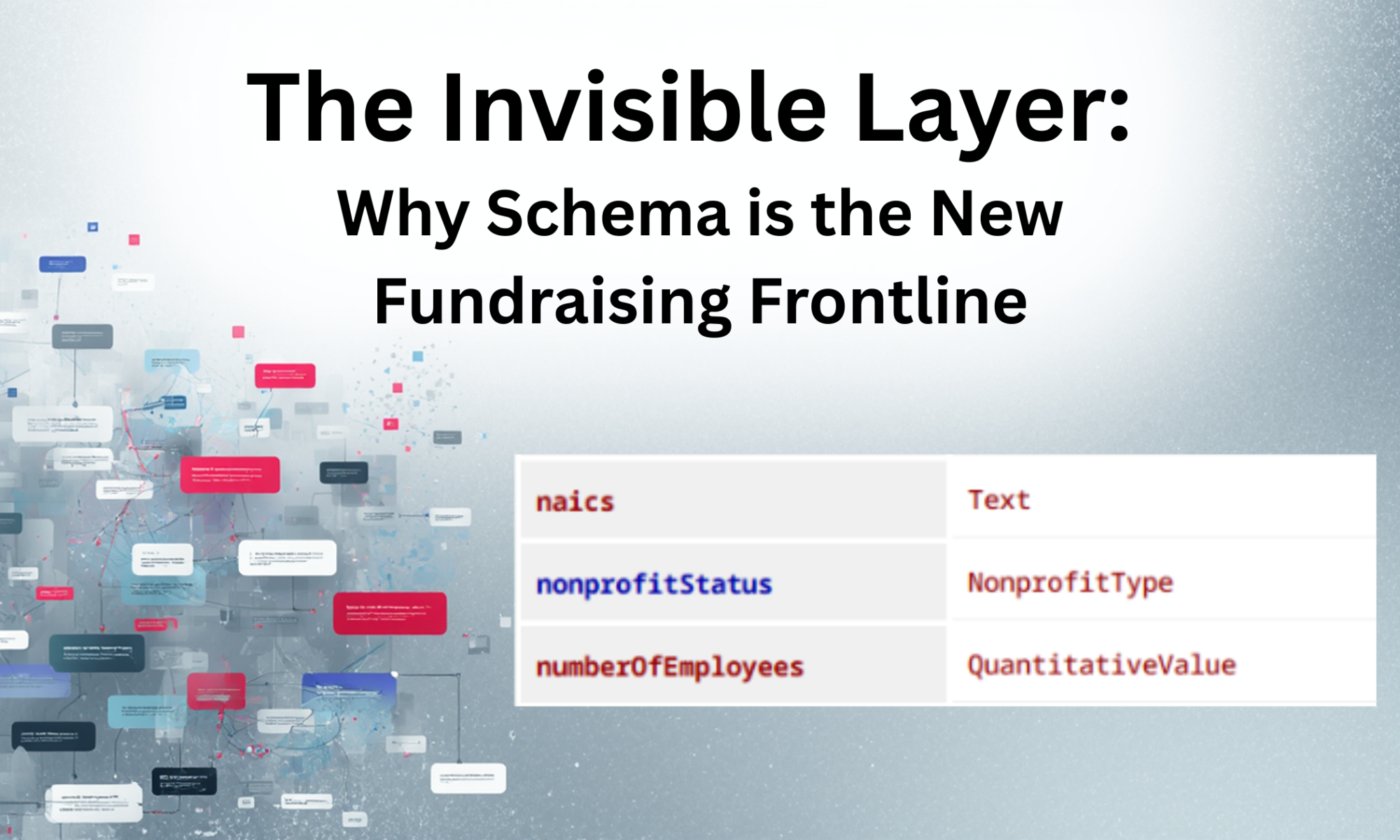
Think of Schema markup as the technical specification sheet for your nonprofit’s soul. While your homepage tells a moving story of human triumph, your Organization Schema translates that story into a legal, verifiable taxonomy. By explicitly defining your mission, brand, and crucial nonprofitStatus properties, you are not merely bragging to a machine; you are submitting structural proof of your legitimacy. This is how you placate Google’s E-E-A-T (Experience, Expertise, Authoritativeness, and Trustworthiness) sensors, proving you are a concrete entity and not a fleeting algorithmic mirage.
Beyond the foundational identity, we must construct the load-bearing walls of engagement through Event Schema. Galas, webinars, and volunteer drives are frustratingly ephemeral unless structurally defined. By tagging your events, you allow AI assistants to proactively place your fundraisers directly into the temporal context of a donor’s calendar query.
Finally, we arrive at the modern marketer’s masterstroke: FAQ Schema. This is quite literally the “cheat code” for the AEO era. When you structure your most common donor inquiries into a machine-readable format, you are feeding the AI the exact script it needs to advocate for your cause. You bridge the gap between human curiosity and machine retrieval, ensuring that when the Oracle speaks, it speaks your name.
III. The Structural Integrity: A Technical Checklist for Leadership
There is a chronic, mildly infuriating tendency among nonprofit executives to banish technical SEO to the IT basement—treating it as a nuisance akin to fixing a jammed printer. This is a catastrophic dereliction of duty in 2026. The Subterranean Architecture requires executive oversight because it directly dictates organizational survival. The first mandate of leadership is strict Validation. You must run your digital properties through the Rich Results Test; it is not enough for the code to merely exist, it must execute flawlessly under scrutiny.
Secondly, leadership must obsess over Speed and Core Web Vitals. Google’s 2026 standards are ruthlessly focused on “Interaction to Next Paint” (INP). To an AI crawler, a sluggish website is interpreted as a crumbling foundation. If your infrastructure hesitates when a user attempts to engage, the Answer Engine will simply bypass you for a more structurally sound competitor, regardless of the nobility of your cause.
Lastly, we must address SSL and Security. In a landscape where data privacy is treated with the reverence of a state secret, a “Not Secure” warning is a structural fault line. You are asking donors for their financial data, which is an extension of their identity. Non-negotiable trust signals must be established at the protocol level. If you cannot secure the connection, you cannot be trusted with the contribution.
IV. The Masonry: Implementing JSON-LD over Microdata
When it comes to the actual application of this architecture, the industry has universally elected JSON-LD (JavaScript Object Notation for Linked Data) as the gold standard. In the dark ages of SEO, developers used Microdata—a chaotic practice of injecting inline attributes directly into the HTML, tangling your data like overgrown ivy choking a beautiful facade. JSON-LD, conversely, is clean, centralized, and sophisticated.
Sitting neatly within the <head> of your webpage, JSON-LD scripts tell a coherent, modular story to the machines without disrupting the visual experience for your human visitors. It is a parallel data layer. Implementing this does not require tearing your website down to the studs.
Whether you deploy this code via the surgical precision of Google Tag Manager or through modern CMS plugins, the process is straightforward. You are essentially pouring a new foundation beneath an existing building. By mastering this technical masonry, you guarantee that your nonprofit transcends beautiful web design, becoming a permanent, verifiable landmark in the AI-driven future.
Artificial Intelligence (AI) is revolutionizing the landscape of higher education marketing, providing tools that streamline the creation and distribution of content. To harness these tools effectively, it’s crucial to understand their potential and how to implement them strategically.
Understanding AI-Generated Content
AI-generated content refers to materials produced by AI algorithms, such as written articles, marketing copy, and visuals. These algorithms can analyze data patterns and generate content with minimal human intervention, enhancing efficiency and consistency in content creation.
In the context of higher education, AI-generated content includes automated marketing materials, course descriptions, personalized student communications, and engagement tools. Universities and colleges use these strategies to create a lasting impression on prospective students.
Key Benefits of AI in Higher Education Marketing
Incorporating AI into higher education marketing strategies presents a myriad of benefits, fundamentally reshaping how institutions engage with their target audience. These advantages include the ability to tailor communication for more effective engagement, analyze data to refine marketing strategies, ensure content resonates with diverse demographics, and provide automated assistance through intelligent chatbots. Let’s explore these key benefits in detail:
AI’s integration into higher education marketing offers several advantages:
Personalized Communication: AI tailors messages to engage prospective students effectively.
Data Analysis: AI analyzes trends and behaviors to optimize marketing strategies.
Content Delivery: AI ensures content resonates with diverse audiences through targeted delivery.
Automated Assistance: AI-driven chatbots provide instant information, guiding students through the application process and answering queries.
Types of AI-Generated Content
The integration of AI technology in higher education marketing enables the creation of diverse and engaging content types. These include visually appealing graphics and images, interactive formats that encourage user participation, automated generation of social media posts, and optimized content for landing pages and blogs. Additionally, AI facilitates the personalization of email campaigns based on user data, as well as the development of immersive virtual tours. Compelling course descriptions further enhance the overall marketing strategy, capturing the attention of prospective students and encouraging further exploration.
Higher education marketers can utilize various forms of AI-generated content, including:
Visual Content: Graphics and images created by AI enhance visual appeal.
Interactive Content: Engaging formats that encourage user interaction.
Social Media Posts: Automated generation of posts for social media platforms.
Landing Pages and Blog Posts: Content optimized for engagement and SEO.
Email Campaigns: Personalized email content based on user data.
Virtual Tours: AI-powered tours that provide an immersive campus experience.
Course Descriptions: Compelling descriptions get prospects to read more.
Developing an AI-Generated Content Strategy
AI has the power to revolutionize content creation. The key to unlocking valuable AI-generated content lies in using the right prompts. Properly framing these prompts and utilizing the tools effectively is crucial.
When developing AI marketing strategies for higher education, keep the following components in mind:
Setting Clear Objectives and Goals
AI serves as a powerful tool, but it’s not a standalone solution. To utilize it effectively, you need clear objectives and goals to engage your audience. Determine whether you want AI to help generate ideas, create written content, produce images, or develop videos for your marketing campaigns. AI can also assist in repurposing existing content and optimizing it for SEO, enhancing your marketing and promotional efforts.
When defining your objectives and goals, consider the following:
Outline Desired Outcomes: Clearly specify the knowledge and skills students should acquire.
Set Quality Benchmarks: Establish standards for content quality to meet educational criteria.
Align Content with Goals: Ensure that AI-generated content supports your defined objectives.
Implement Feedback Loops: Regularly refine and improve AI-generated content based on feedback.
Address Ethical Concerns: Maintain academic integrity by addressing ethical considerations.
Understanding your purpose and the specific achievements you seek through AI-generated content is crucial.
Understanding the Target Audience
Knowing your target audience is vital for creating effective content in higher education. Tailoring content to students’ needs, preferences, and academic goals boosts engagement and enhances learning outcomes.
To understand your target audience for higher education marketing using AI tools, consider:
Demographic Analysis: Study the demographic characteristics of your audience.
Prior Knowledge Levels: Assess the existing knowledge base of your audience.
Learning Preferences: Identify how your audience prefers to learn.
Cultural Diversity: Recognize and respect cultural differences within your audience.
Language Proficiency: Account for varying levels of language skills.
Technological Familiarity: Gauge your audience’s comfort with technology.
Academic Goals: Understand the educational aspirations of your audience.
This comprehensive understanding ensures that your educational materials are relevant, accessible, and resonate with the diverse needs of the student body, thereby enhancing your lead generation efforts in higher education marketing.
Selecting the Right AI Tools and Platforms
AI tools allow knowledge workers to analyze data, make predictions, and perform tasks more efficiently. Before investing in an AI platform, consider these key factors:
Flexibility and Compatibility: Ensure the tool integrates smoothly with your existing systems.
Scalability: Look for tools that can handle deep learning and grow with your needs.
Budget: Make sure the cost aligns with your financial constraints.
Algorithms and Optimization: Choose tools with powerful algorithms and optimization capabilities.
Security and Compliance: Ensure robust security measures and regulatory compliance.
Pre-Built APIs: Look for tools with pre-built cognitive APIs to speed up implementation.
Third-Party Integration: Verify that the tool integrates with other platforms you use.
Customized Support: Opt for tools that offer tailored support services.
Transparent Pricing: Seek clear and straightforward pricing models.
Trial Period: Test the platform before committing to a purchase.
Consider your project’s specific needs, the learning curve, and future planning when selecting an AI platform.
Content Creation and Curation
In higher education marketing, effective content creation and curation are essential for attracting and retaining students. Tailor your content to highlight academic excellence, campus life, and career opportunities to engage prospective students.
Strategies include:
Creating Compelling Content: Develop blog posts, videos, and social media content that showcase unique aspects of your institution.
Curating Existing Content: Select and organize existing materials to build credibility and authority. A well-executed strategy positions your institution as a thought leader and fosters trust.
Writing AI-Generated Articles:
Use AI algorithms to generate written content. Leverage natural language processing to create coherent, contextually relevant articles, saving time and enhancing productivity.
Creating AI-Generated Visuals:
Utilize AI to generate images, graphics, or multimedia content. This enhances visual appeal and supports communication, ensuring efficiency and creativity in visual representation.
Quality Control and Human Oversight
In higher education content generation, quality control and human oversight are crucial. Human oversight is necessary to review, refine, and correct AI-generated content, ensuring it aligns with academic integrity.
Establish rigorous quality standards to maintain accuracy and meet educational objectives. This process helps mitigate biases, ethical issues, and content inaccuracies, balancing technological capabilities with human expertise.
As a higher-education marketer, it’s essential to ensure your content resonates with the target audience and meets high standards of relevance, reliability, and educational efficacy. Additionally, AI can suggest various methods and strategies to personalize your content effectively.
Ensuring Compliance and Ethical Considerations
While AI can boost productivity and creativity in higher education, it also raises ethical questions, such as the implications of machines mimicking human creativity and authorship.
Reliability and accuracy are paramount when using AI content-generation tools. Since these tools depend on algorithms and machine learning, there’s a risk of producing false or misleading information. Regular updates and rigorous testing can improve the reliability and accuracy of AI-generated content.
Ethical considerations for using AI content tools in higher education include:
Transparency, Disclosure, and Accountability: Clearly communicate the use of AI and be accountable for its outputs.
Data Privacy and Protection: Safeguard personal information used by AI tools.
Social and Cultural Implications: Be mindful of the social and cultural impact of AI-generated content.
Copyright Laws and Fair Use Doctrine: Adhere to copyright regulations and ensure fair use.
Plagiarism and Copyright Infringement: Avoid plagiarism and respect intellectual property rights.
Proper Attribution and Citation: Accurately attribute sources and provide proper citations.
By following industry standards and best practices, AI tools can achieve higher accuracy and reliability, enhancing their overall value.
Implementing an AI-Generated Content Strategy
Integrating an AI-generated content strategy in higher education marketing requires seamless coordination with existing efforts to boost engagement and communication. By utilizing AI to create customized content for diverse audiences, institutions can deliver personalized messages that resonate with prospective students, faculty, and stakeholders.
To refine strategies, it is crucial to measure and evaluate the performance of AI-generated content. Employing key performance indicators (KPIs) such as engagement rates, conversion metrics, and audience feedback ensures a data-driven approach. Continuous improvement and optimization, driven by analytics, allow higher education marketers to adapt dynamically, maintaining relevance and impact.
The Future of AI in Higher Education Marketing
AI is set to elevate higher education marketing strategies to new heights. Its future is multifaceted, addressing everything from personalized learning to operational efficiency. AI tools play a significant role in creating adaptive learning programs tailored to each student’s needs.
Personalized Learning Paths: Combining digital marketing with AI-generated content allows for educational materials tailored to individual needs, enhancing engagement and performance by offering a customized learning experience.
Chatbots for Student Support: AI-powered chatbots assist prospective and current students with inquiries, applications, and general support. They provide instant responses, improving efficiency and enhancing the overall student experience.
Predictive Analytics for Student Success: Utilizing machine learning algorithms, institutions can predict factors affecting student success, identifying at-risk students early. This proactive approach enables targeted interventions, improving retention rates and overall academic outcomes.
Final Thoughts
AI is revolutionizing higher education by employing data-driven strategies that engage students and enhance their academic journey. It disrupts administrative, teaching, learning, and research activities, transforming the future of education.
In higher ed marketing, an AI-generated content strategy not only improves outreach but also personalizes it, boosting student recruitment and enrollment. Understanding prospects more deeply allows for a nuanced grasp of their behavior, preferences, and needs.
By embracing AI, higher education institutions can leverage its potential for improvement across the board. With guidance from higher education marketing consultants, AI can help tailor lesson plans, assessments, and overall student experiences, driving significant advancements in education.